- contact@divsystems.in
- Mon - Fri: 10.30 am - 7.30 pm
We are creative, ambitious and ready for challenges! Hire Us

Overview
Div Systems built the plant-floor materials system for a fine chemicals manufacturer, covering purchase requisitions with full financial coding, stores issue and return, goods receipt, finished-goods pallet management and export loading verification.
Requisitions carry budget, internal order, GL code and cost centre. Stores issues draw against live stock. Goods receipts reference the SAP purchase order and goods receipt numbers, so the plant system and the ERP stay tied together. On the output side, production batches become numbered pallets with QR codes, pallets are allocated to export orders and scanned during loading, and batches can be held in quarantine until quality releases them.
Business need
A chemicals plant runs two inventory problems that behave nothing like each other. On the input side there are engineering spares, consumables, safety equipment and services, ordered by many departments against budgets and cost centres. On the output side there is finished product in batches, which cannot be sold until quality releases it and which leaves in containers that must be loaded correctly.
Enterprise systems handle the financial record of both. What they handle less well is the physical work in between: the storekeeper issuing an item at a counter, the operator building a pallet, the loader scanning it into a container. That gap is where inventory accuracy is lost, and the auditors have measured the consequences.
A Comptroller and Auditor General performance audit of a large public sector manufacturer found non-moving inventory running between 6.1 and 8.4 per cent of total inventory against an internal norm of 3 per cent, and stock verification not carried out half-yearly in 46 of 49 stockyards. An older CAG audit of stores accounting is even more direct about the mechanism: seven divisions carried cumulative negative stock balances worth ₹15.22 crore. A negative quantity is physically impossible. It means issues were recorded that receipts never were, or material left without a document at all.
The plant needed a system that could:
Our solution
The system does not try to be the ERP. Purchasing commitment, vendor accounting and financial posting stay in SAP. What this system owns is the plant's own working record: the requisition and its approval, the physical stock in stores, the issue at the counter, the goods physically received, the pallet in the warehouse and the material crossing the gate.
The join is deliberate and narrow. A goods receipt here captures the SAP purchase order number and the SAP goods receipt reference alongside the gate entry number, so a plant record can always be traced to its ERP counterpart and back to the vehicle that brought it. That is enough to reconcile without duplicating the ERP.
Everything downstream of that reads from the same stock figures, which is what makes an issue slip refuse to over-issue and a reorder alert mean something.
Key features
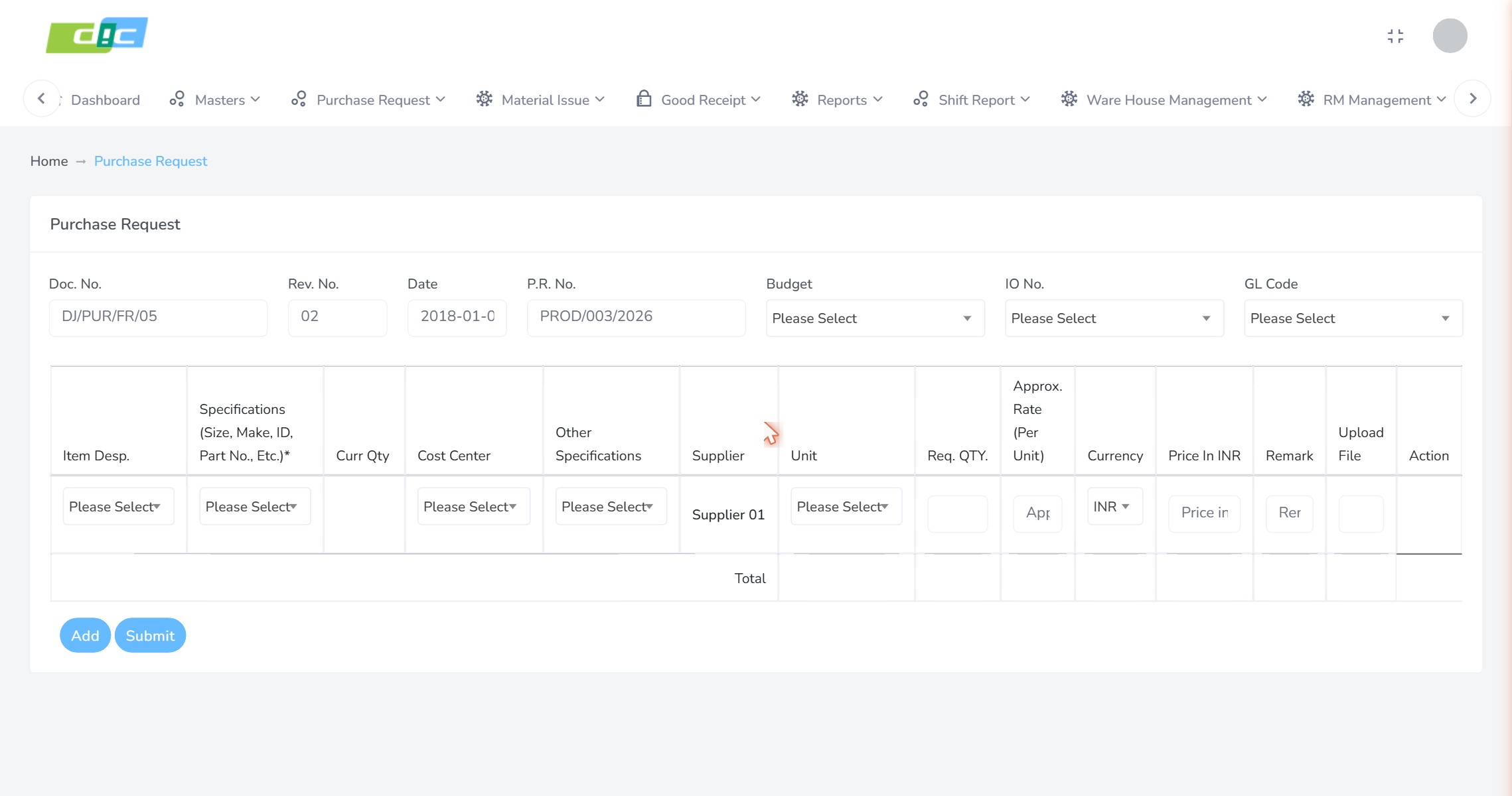
Budget as capital or revenue, internal order, GL account and cost centre are captured on the requisition, so spend is classified before it is committed.
Requisitions carry a document number and revision number, which is what makes a controlled form auditable rather than just printable.
Line items are typed as goods or services, with specifications, part numbers, supplier, unit, quantity, rate, currency and value in rupees.
Imported items are requested in their own currency with the rupee value alongside, so approval sees a comparable figure.
The issue slip shows available quantity per item as it is raised, with department and recipient recorded, plus a return route for unused material.
Receipts carry the document date, requisition number, gate entry number and the SAP purchase order and goods receipt references.
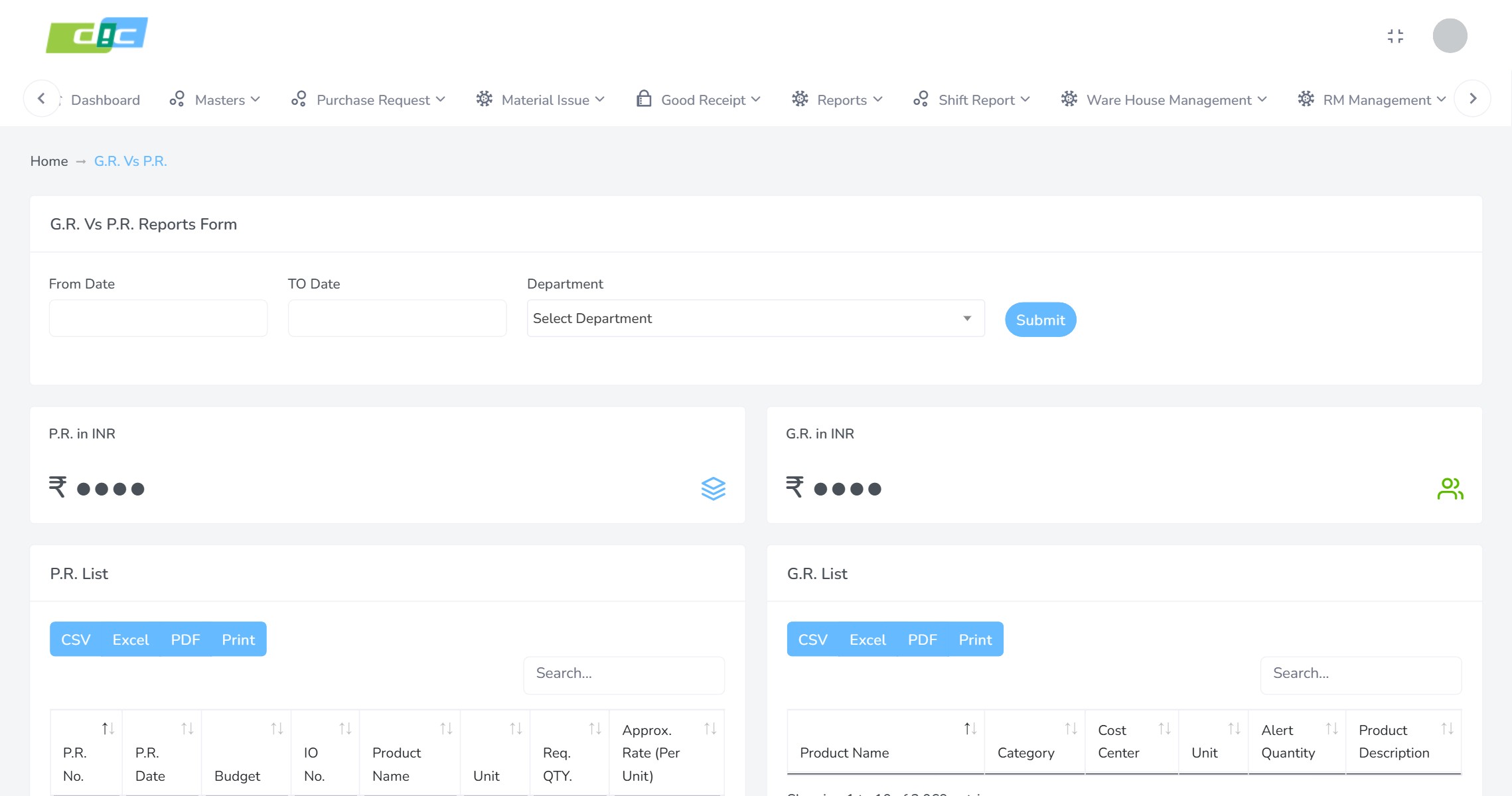
A dedicated report puts requisition quantity, rate and currency beside the receipt date and quantity, so shortfalls and over-receipts are visible.
Each item carries its own alert quantity next to current stock, turning replenishment into an exception list rather than a monthly review.
Production batches become numbered pallets with final product, batch number, production date, quantity, net weight and a QR code.
Pallets are mapped to a warehouse and location, filterable by product, batch, mapping state, pallet status and available stock.
A batch can be placed on hold with a reason, recorded holder and date, then released with its own reason and approver, showing the pallets affected.
Export orders carry a pallet list, a loading list, a scanned list and a pending-scan count, so a container is not closed on an assumption.
Any pallet can be traced through its movements, which is what makes a batch enquiry answerable after despatch.
Inward, issue and return for raw materials record the SAP code, location and the quantity before and after, with the user and timestamp.
Gate passes are typed as returnable or non-returnable, with expected return date, job work reference, transport mode and separate approval and receipt records.
Inside the platform
Screens from the live system. Supplier names, personnel names, finished-product codes and monetary values are masked; structure and workflow are unchanged.
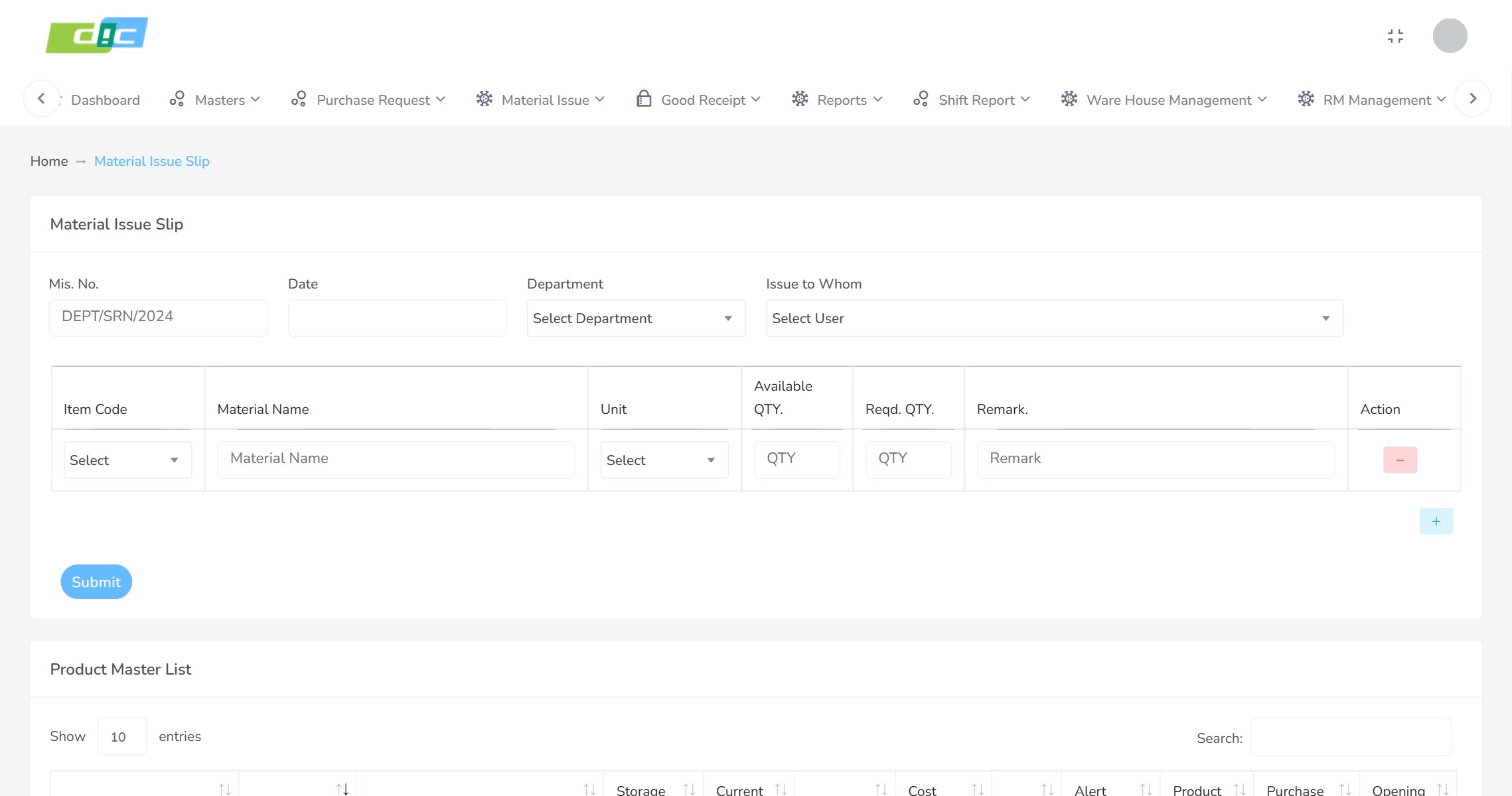
The issue slip is raised against a department and a named recipient, and each line shows the available quantity for that item as the storekeeper types. Unused material goes back through a return route rather than reappearing informally.
This is the control that prevents the condition auditors keep finding in stores accounting: negative on-hand balances, which can only arise where issues are recorded against receipts that were not, or where material left with no document at all.
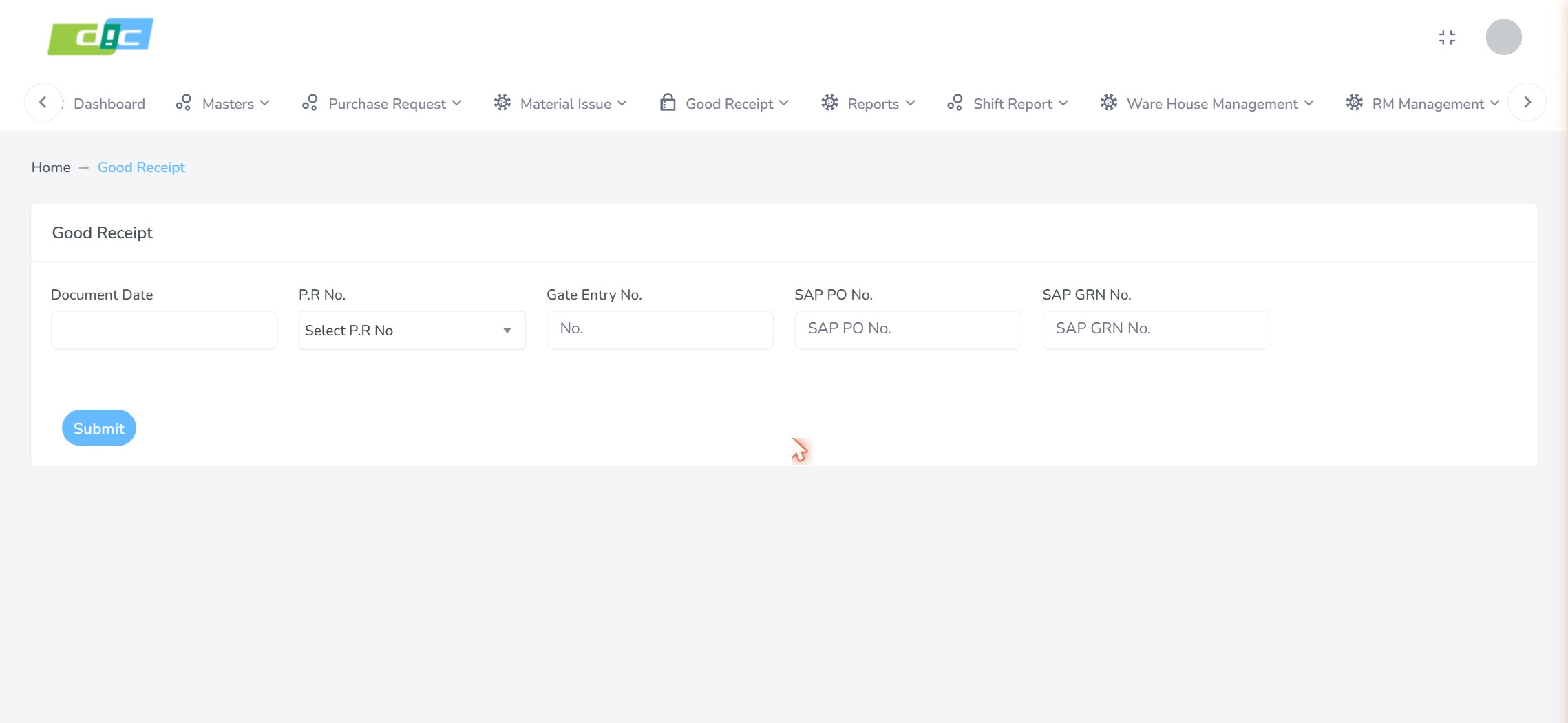
Commitment to a supplier lives in SAP, as does the financial posting. The value of capturing those references here is reconciliation: a plant record that names its purchase order and its goods receipt can be matched to the ERP without anyone exporting a spreadsheet.
Worth being precise about terms, because they are widely muddled. The three-way match that protects a payment is between the purchase order, the goods receipt and the supplier invoice. The requisition is not one of those three; it is the authorisation and budget check that happens before any commitment exists. In a chemicals plant a fourth leg is meaningful too, because acceptance depends on a certificate of analysis rather than on arrival alone.
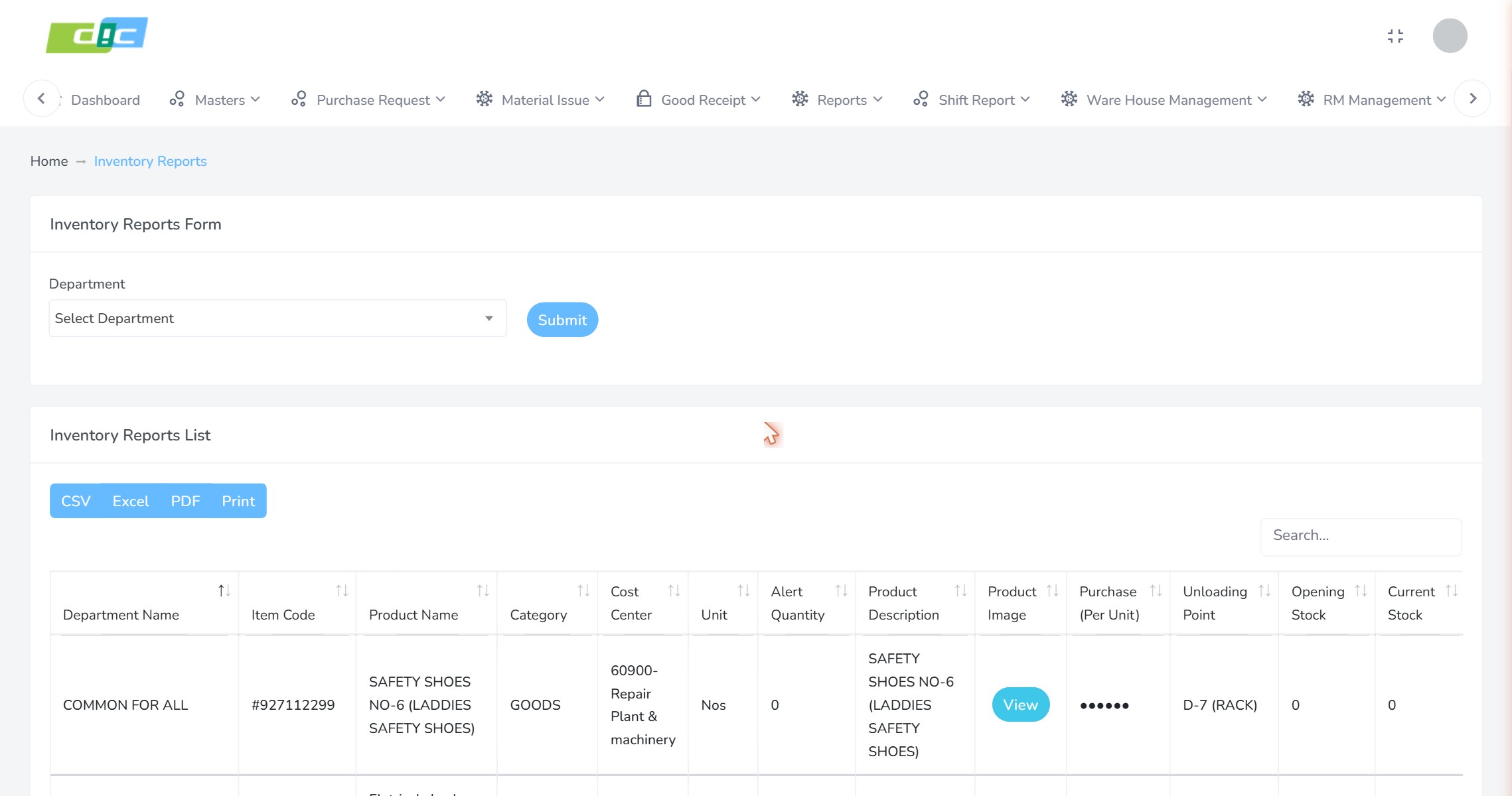
The requested-against-received report sets requisition number, date, budget, internal order, product, quantity, rate and currency beside the receipt date, receipt number and the resulting stock position.
It answers the question a stores function is asked most often and can least easily prove: whether the thing that was requisitioned, approved and ordered actually turned up, in the quantity intended, and where it now sits.
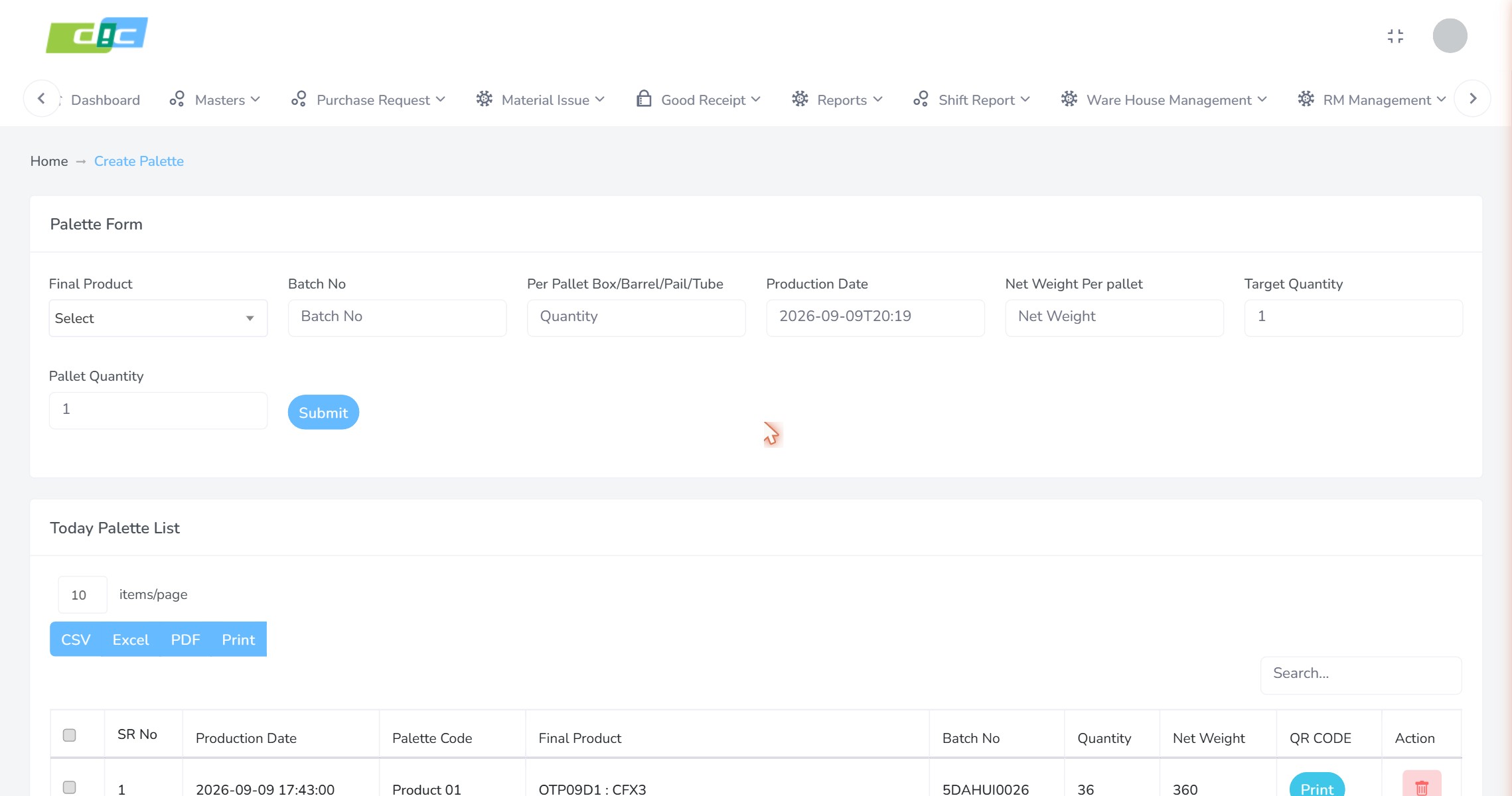
Production output is packed to a defined number of boxes, barrels, pails or tubes per pallet, and each pallet is created against its final product and batch number with a production date, net weight and quantity. The system issues the pallet code and a QR label.
That identity is what everything after it depends on. A pallet with a code can be given a warehouse location, allocated to an order, scanned at loading and looked up months later. A pallet identified only by a handwritten card cannot.
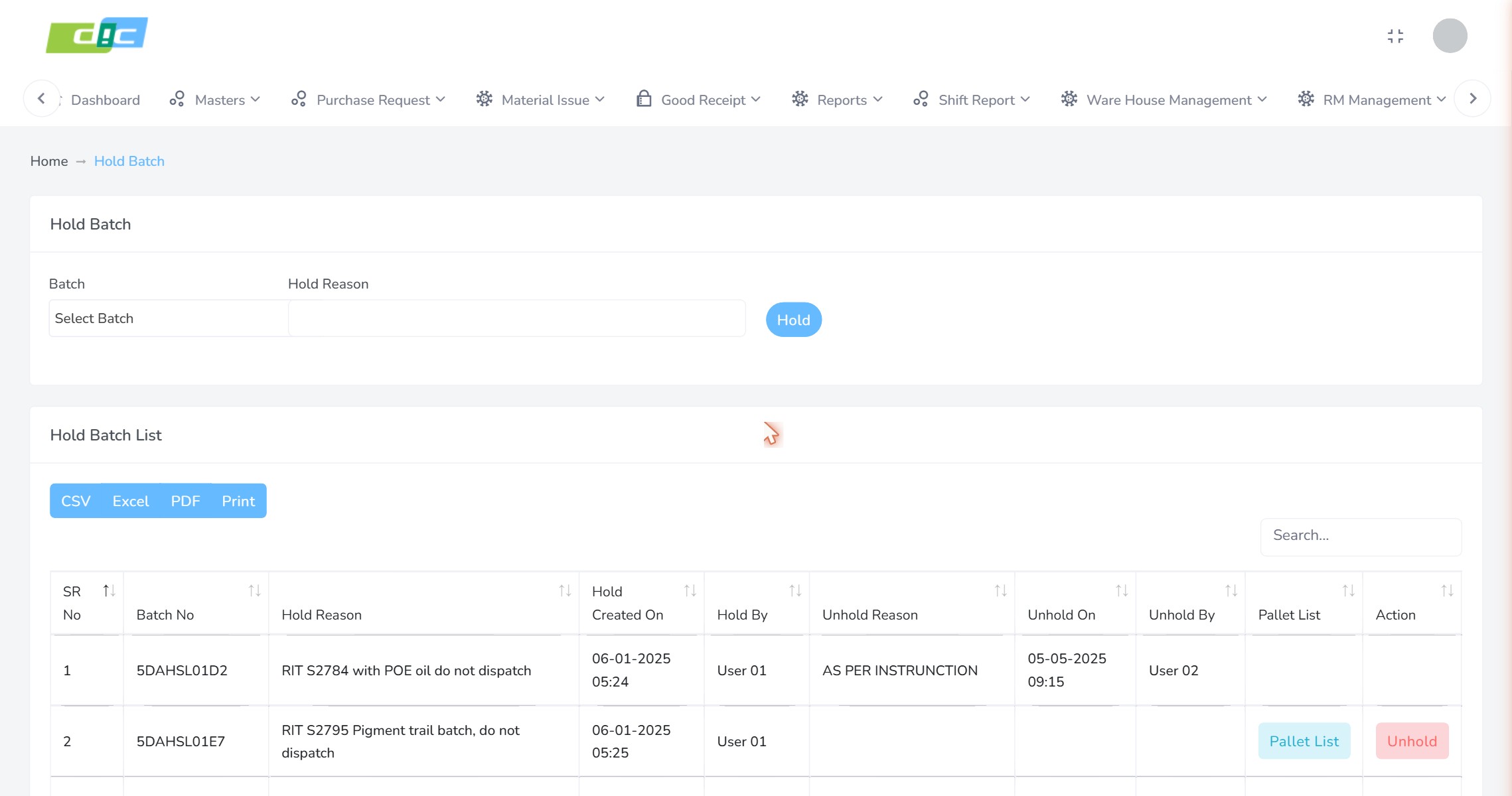
A batch can be placed on hold with a stated reason, the person who held it and the date, and released later with its own reason, person and date. The pallets belonging to that batch are listed against the hold.
Physical completion of a batch and its fitness for sale are different events, separated by sampling, analysis and a documented release decision. Guidance for active pharmaceutical ingredients puts it plainly: material is held under quarantine until it has been sampled, examined or tested and released. Quality management standards require the status of output with respect to monitoring and measurement to be identified throughout. Holding that status as data, attached to the pallets it affects, is what stops a held batch being picked in good faith.
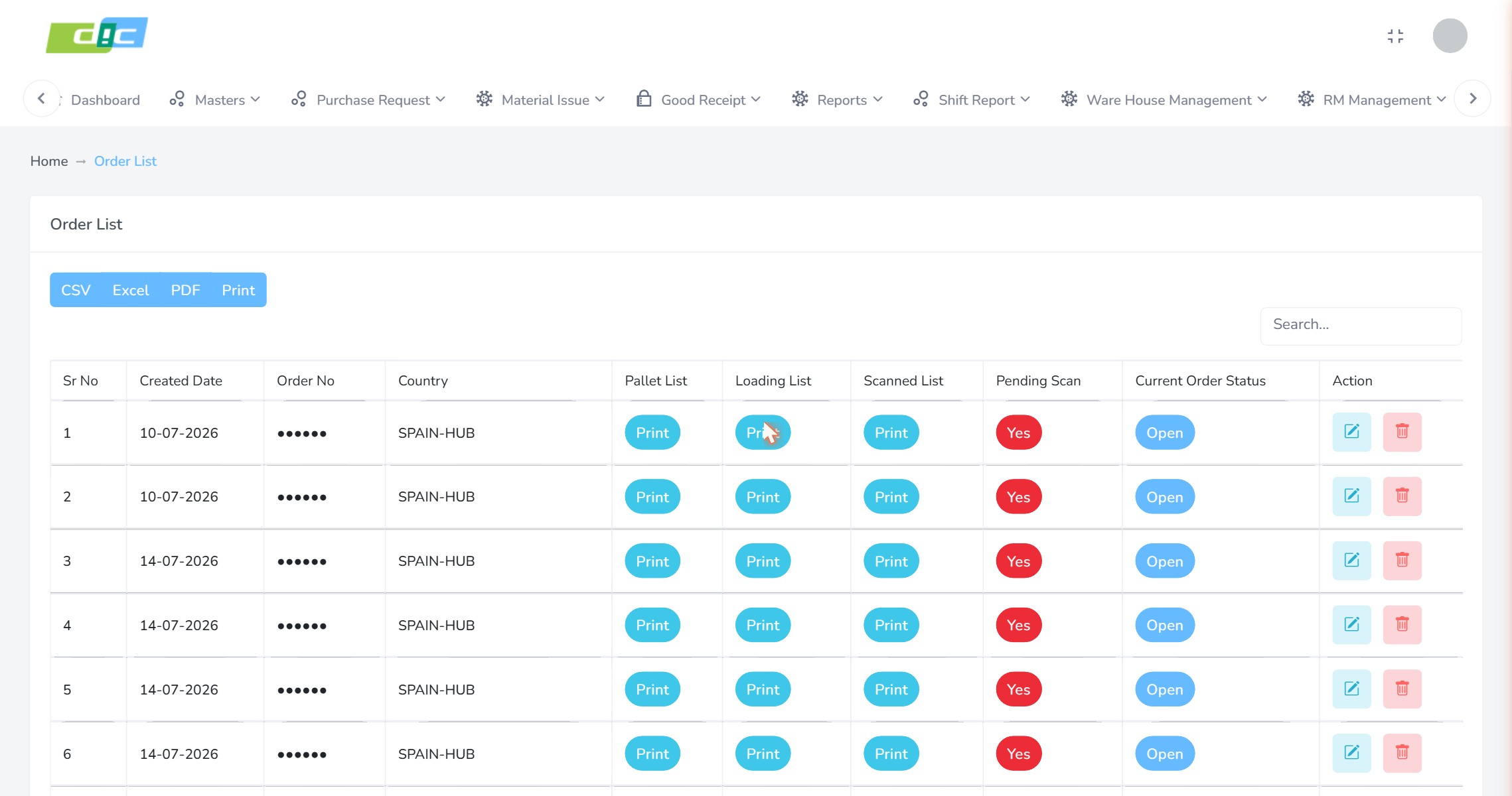
An export order carries the pallets allocated to it, the loading list, the pallets actually scanned and the count still outstanding, alongside the destination country and the order's current status.
The control is simple and hard to argue with. A container should not be sealed while the pending scan count is above zero. Comparing intent against what was physically scanned is the difference between believing the right goods were loaded and being able to show it, which matters most when a customer on another continent disputes a shipment.
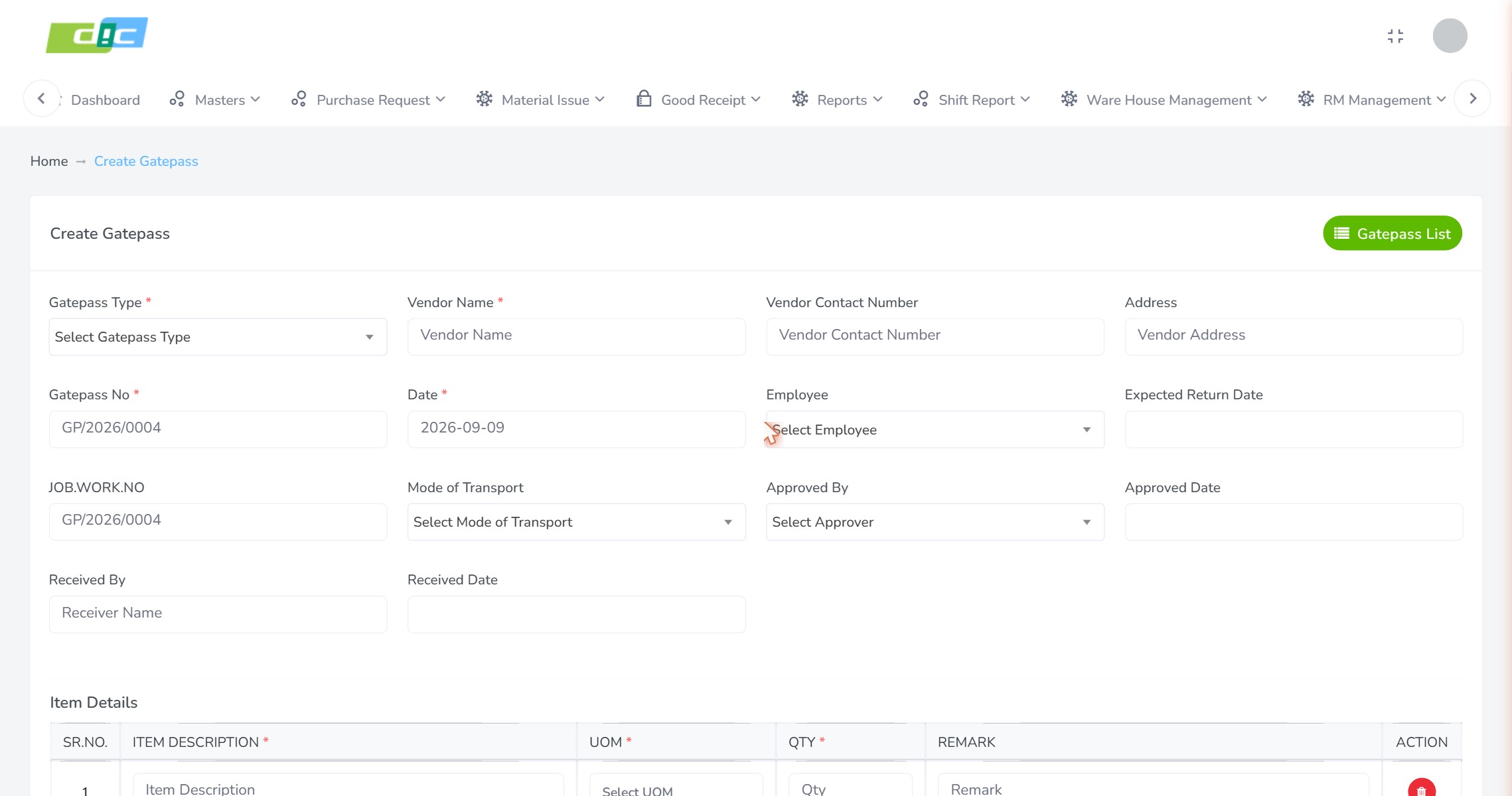
Gate passes are typed, including returnable and non-returnable variants and the zone-specific types this site uses. Each carries the vendor, an expected return date, a job work reference, mode of transport, and separate records of who approved it and who received the goods back.
The expected return date is the working part. Material sent out for repair, calibration or job work is easy to authorise and easy to forget, and an unreturned item is both a stock loss and, where goods went out for job work, a tax exposure with a statutory clock attached to it.
Worth stating plainly, because vendors often blur it: a gate pass is a custody document of the plant's own making. The instrument that legally covers goods moving without a sale is the delivery challan, with an e-way bill where the rules require one.
End to end
Materials flow inward to the stores counter; product flows outward to the container. Both are recorded here.
Impact
Spend is classified at source. Budget, internal order, account and cost centre are entered when the need arises, not reconstructed at month end.
Stock figures are usable. Availability shows at the counter, so an issue slip reflects what is on the shelf rather than what was on it last week.
Replenishment is an exception list. Alert quantity per item turns reordering into a short list rather than a review of everything.
Batch status is enforced, not advisory. A held batch carries its hold to every pallet in it, with the reason and the person recorded at both ends.
Loading is evidenced. Scanned against allocated turns a despatch claim into a record that can be produced.
The ERP stays authoritative. Plant records reference their SAP documents rather than competing with them.
Engineering approach
Capturing the SAP purchase order and goods receipt references was enough to make plant records reconcilable, without rebuilding procurement or accounting.
Budget, internal order, GL account and cost centre belong on the requisition, because that is the only moment the requester knows why the spend exists.
A pallet is created and coded before it is located, allocated or loaded, because every later control depends on that identifier existing.
A hold is placed on a batch but has to be felt by each pallet, so the relationship is modelled rather than left to a flag someone remembers to check.
Pending scan is a more useful number than scanned count, because the outstanding items are what stop a container from closing.
An expected return date on a gate pass is what converts a custody note into something that can be chased before it becomes a loss.
Common questions
Because the ERP holds the financial and commitment record, while much of the risk sits in physical work it does not reach: the issue at the stores counter, the pallet built on the packing line, the scan at the container door. A plant layer that references the ERP's documents closes that gap without duplicating it.
It matches the purchase order, the goods receipt and the supplier invoice: what was agreed, what arrived, and what is being billed. The purchase requisition is not one of the three, despite being described that way frequently. It is the internal authorisation and budget check that happens before a commitment exists. In a chemicals plant a fourth leg is worth adding, since acceptance depends on the certificate of analysis, not just on delivery.
No. Returnable and non-returnable gate passes are plant custody practice, not statutory instruments. The document that legally covers goods moving without a supply is the delivery challan under the GST rules, with an e-way bill where required. A gate pass is still worth running properly, because it is what makes the return actually happen.
Where goods went out for job work, GST law gives the principal a limited window to bring inputs or capital goods back, and treats them as supplied on the original despatch date if that window passes. The exposure is backdated rather than current, which is why an expected return date sitting on the pass is a genuine control rather than housekeeping.
Loading the wrong batch, loading a held batch and short-loading a container. Comparing what was allocated against what was scanned produces a pending count, and a container that closes with that count above zero is a mis-shipment waiting to be discovered by the customer instead of the loader.
The shape holds for most process manufacturers: coded requisitions, stores issue against live stock, receipt reconciled to the ERP, batch-identified finished goods and verified loading. What changes is the coding structure, the packing configuration and the release rules, which follow the plant's own quality system.
Why Div Systems
We build the operational layer that sits between an ERP and the shop floor, for manufacturers whose real risk lives in physical movements rather than in ledgers. The work starts with walking the process, from the stores counter to the container door, and ends with a system the people doing that work will actually use.
Start your project