- contact@divsystems.in
- Mon - Fri: 10.30 am - 7.30 pm
We are creative, ambitious and ready for challenges! Hire Us

Overview
Div Systems built the gate control system for a pharmaceutical special economic zone, covering goods movements across the customs boundary, visitor and contractor access, identity cards, RFID gate scanning, weighbridge tickets and a closed-loop canteen wallet.
Seven categories of goods gate pass run through their own approval routes, identity cards are issued and mapped to RFID credentials, gate scans are logged, and a mobile application extends the system to staff working away from a desk. Twelve roles separate the estate operator, the unit managers, security, HR, medical and the customs officer.
Business need
Under section 53 of the Special Economic Zones Act 2005, an SEZ is deemed to lie outside the customs territory of India for the purposes of its authorised operations. That single sentence is why the gate matters. Goods inside the zone have not paid duty, and the gate is where the state's claim on them is either preserved or lost.
The consequences of weak gate control are documented rather than hypothetical. In its performance audit of special economic zones, the Comptroller and Auditor General recorded a fraud at an SEZ unit involving the misappropriation of 1,794 laptops worth about ₹5.5 crore, at a zone where the authorised officer was working from inside that very unit rather than at the gate. The audit's own assessment was that proper control over the movement of goods at the SEZ gate could have avoided the fraudulent removals.
An estate operator therefore needs to run several different control problems through one system:
Rule 70 of the SEZ Rules requires a record of entries to be maintained at the zone gate, but specifies no medium, so a paper register satisfies the letter of it. A register cannot reconcile itself against a unit's filings, cannot show which temporary removals are overdue, and cannot tell a security officer at 2am whether the person at the barrier still holds a valid card.
Our solution
Goods movements and people are modelled separately, then joined at the gate. A movement is raised as a gate pass of a specific category, carries a request identifier and an item count, and moves through approval to a posting officer. A person holds an identity card with a validity window, which is mapped to a QR code and an RFID credential.
At the barrier, a scan writes an event against whichever of those it belongs to, so the gate log is a single chronological record of everything that crossed. Because both sides are structured, the estate can answer the question a register cannot: what is currently inside that should not be, and what left that has not come back.
Around that sit the supporting records an estate actually runs on: contractor and visitor entries, employee vehicles, weighbridge tickets, medical records and a cashless canteen balance carried on the same card.
Key features
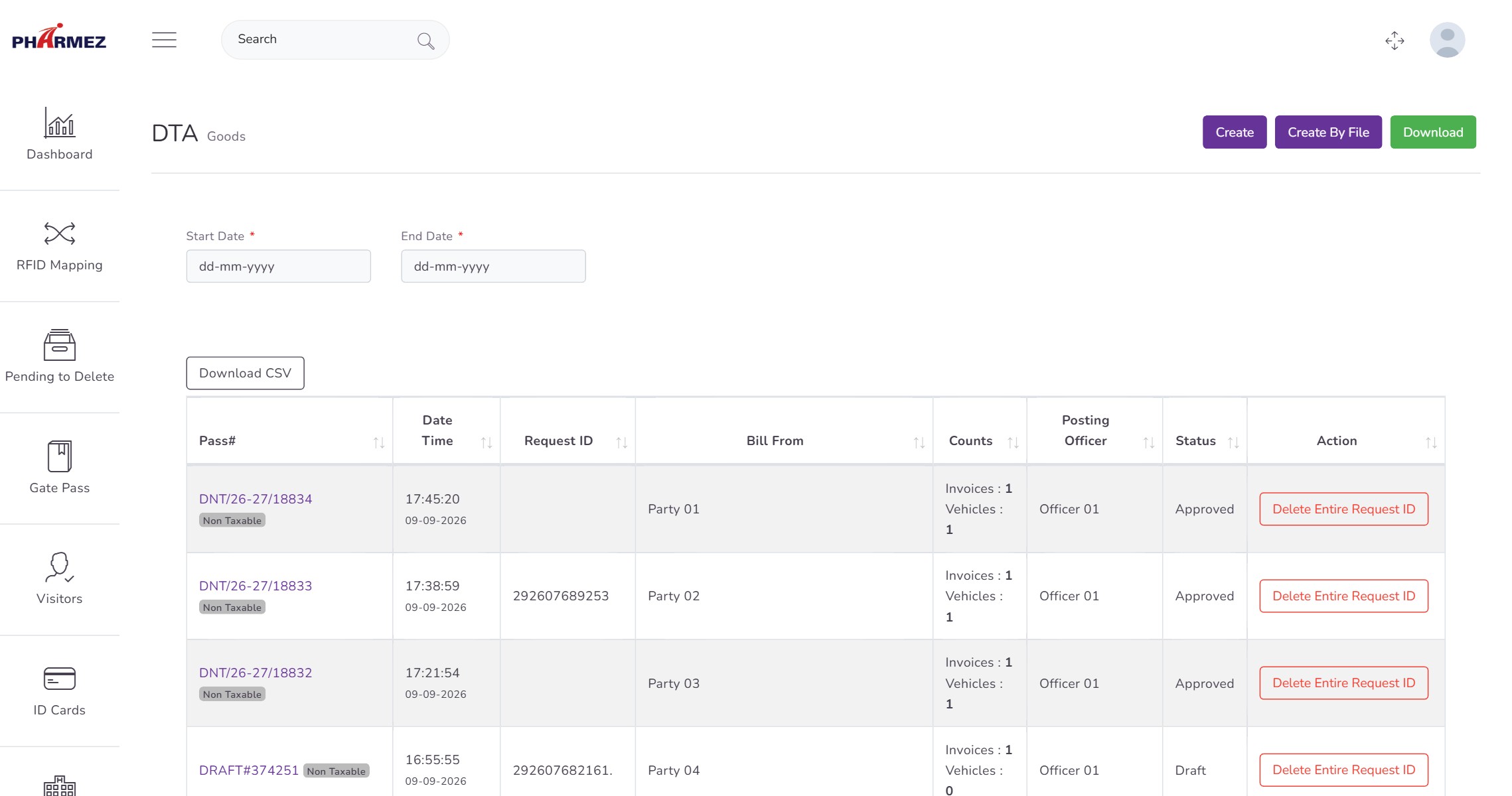
Domestic tariff area removal, imported goods, contractor material, temporary removal, zero rated, soil filling and export, each with its own register and route.
Passes carry a request identifier and item counts, so a multi-line consignment is handled and withdrawn as one unit rather than line by line.
Passes move through states such as draft and pending approval, with the posting officer recorded against each one.
Deletion is a request rather than an action. A pending-to-delete queue holds withdrawals until someone with authority clears them.
Large consignments are loaded from an uploaded file instead of typed, and exported back out as CSV for reconciliation.
Temporary and permanent cards carry validity dates, unit, contractor and status, with webcam capture, bulk approval and bulk printing.
A card is mapped to a QR code and an RFID credential, so the same identity works at a reader, on a printed pass and in the mobile app.
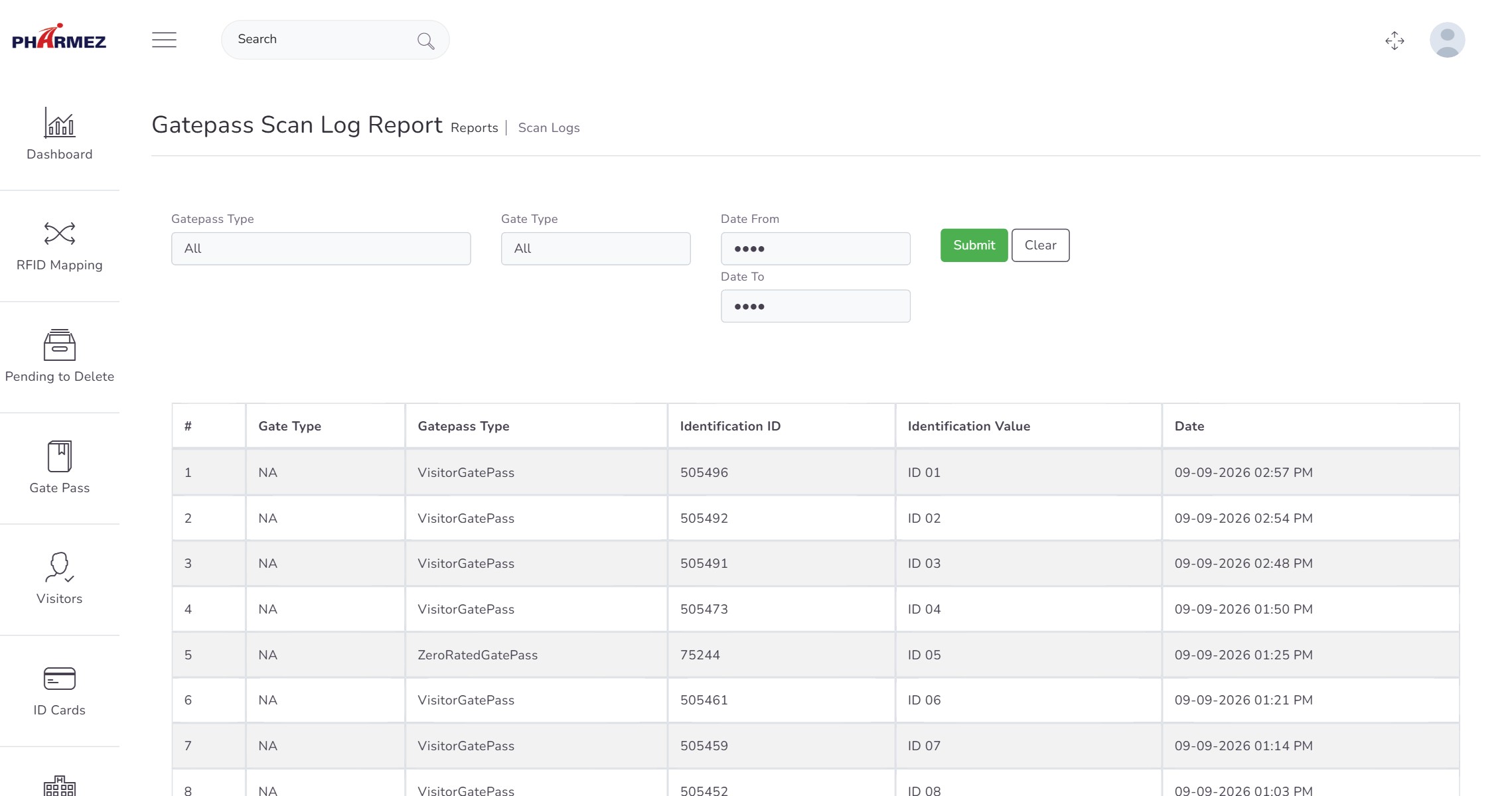
Every scan records gate, pass type, credential and timestamp, giving a continuous chronological record of crossings.
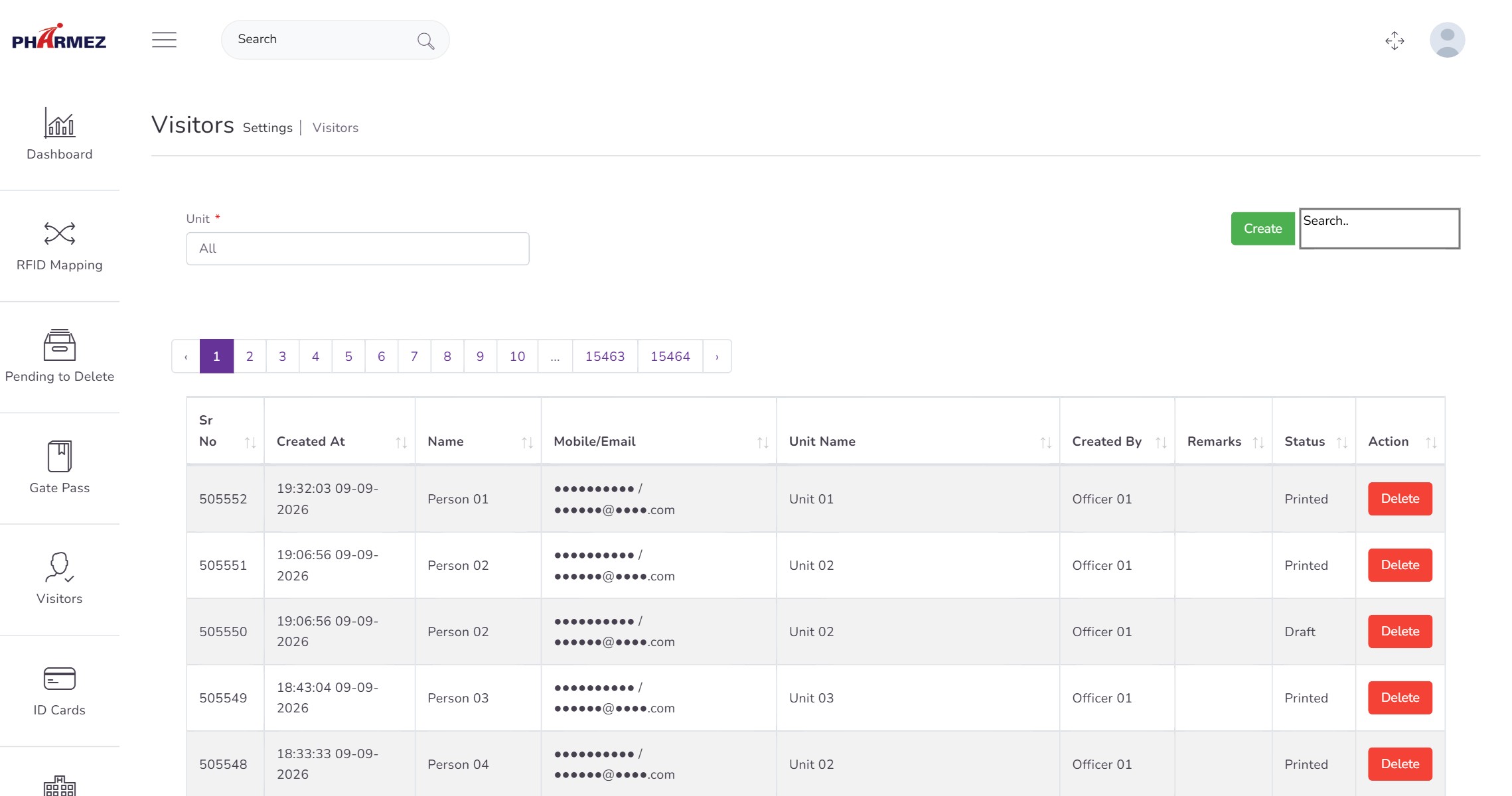
Visitors and contractor personnel are registered against a host unit with contact details, remarks and status.
Ticket number, party, vehicle, material, gross, tare and net weight and charges are held per weighing and reported by unit and date.
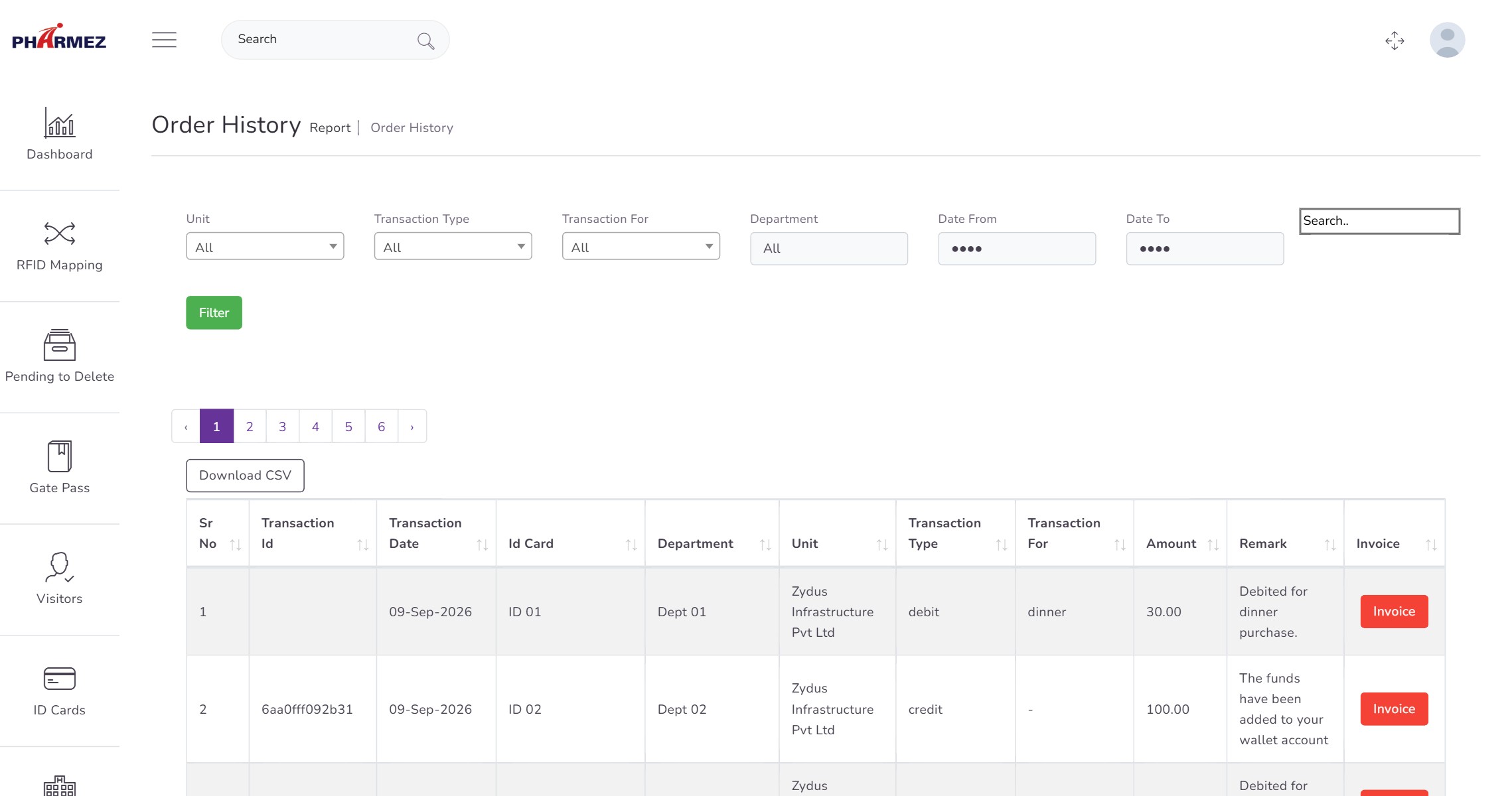
The identity card carries a balance spent on site, with a transaction ledger by department and unit, recharge history and failed payment tracking.
Estate admin, unit manager, security officer, gate security, customs officer, HR, medical, store, contractor and app user each see their own scope.
A dedicated app user role extends scanning and lookups to staff working at gates and around the estate rather than at a desk.
Print and deletion logs record what was issued and what was withdrawn, alongside card entry and demographic reporting.
Daily and gate pass reports, visitor and export reporting, vehicle listings and wallet order reports all filter by unit and date range.
Inside the platform
Screens from the live system. Unit names, personnel names, photographs, contact details and vehicle registrations are masked; structure and workflow are unchanged.
The categories are not cosmetic. A domestic tariff area removal is legally an import into India and is assessed as one. Imported goods entering the zone are examined at the gate. Temporary removal covers goods going out for repair, testing, calibration or exhibition on an undertaking that they return. Contractor material entering for works is different again.
Each has its own register, its own approval route and its own reporting, because the question an officer asks of each is different. The one question common to all of them, and the one a paper register answers worst, is which movements are still open.
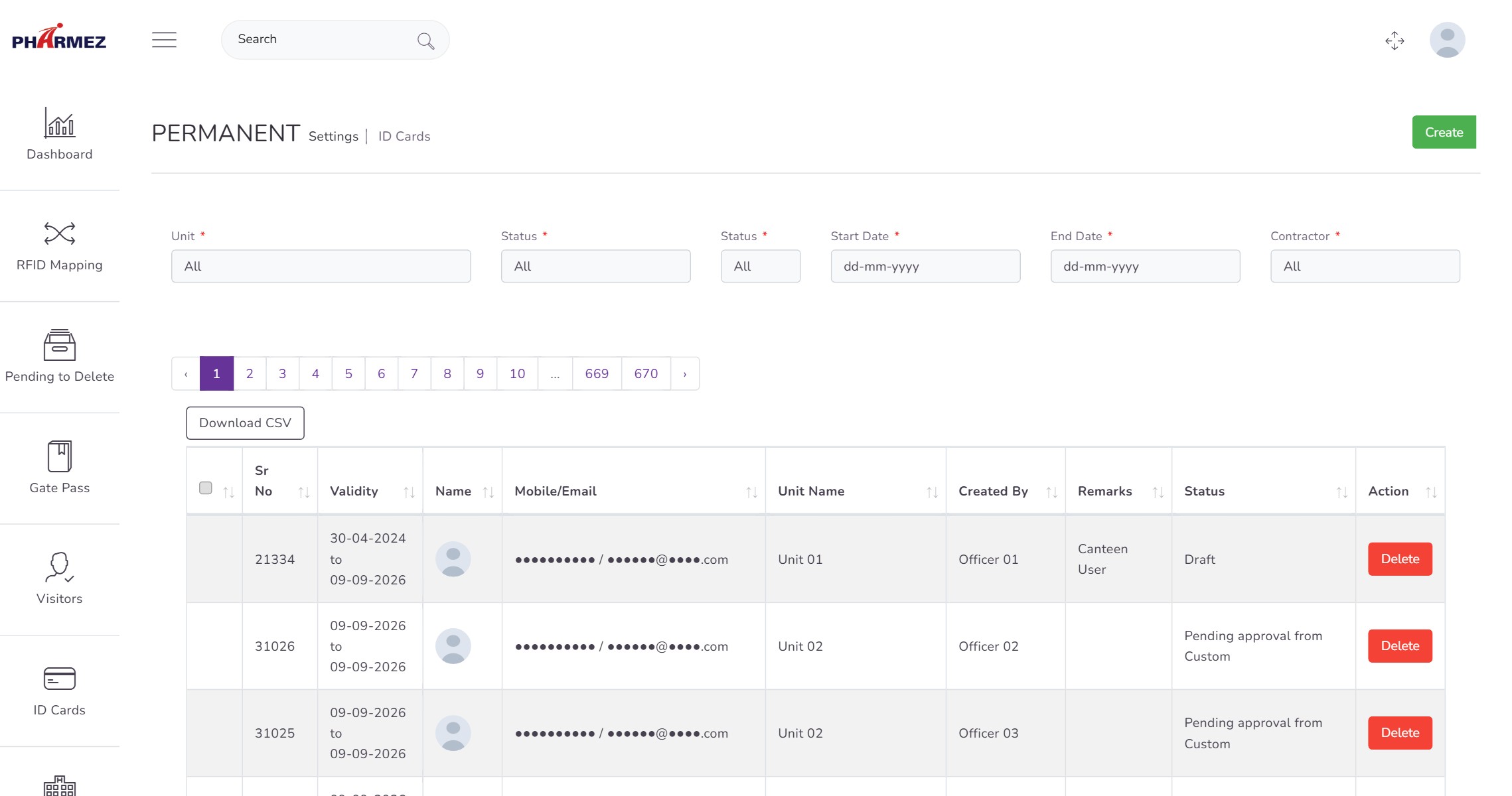
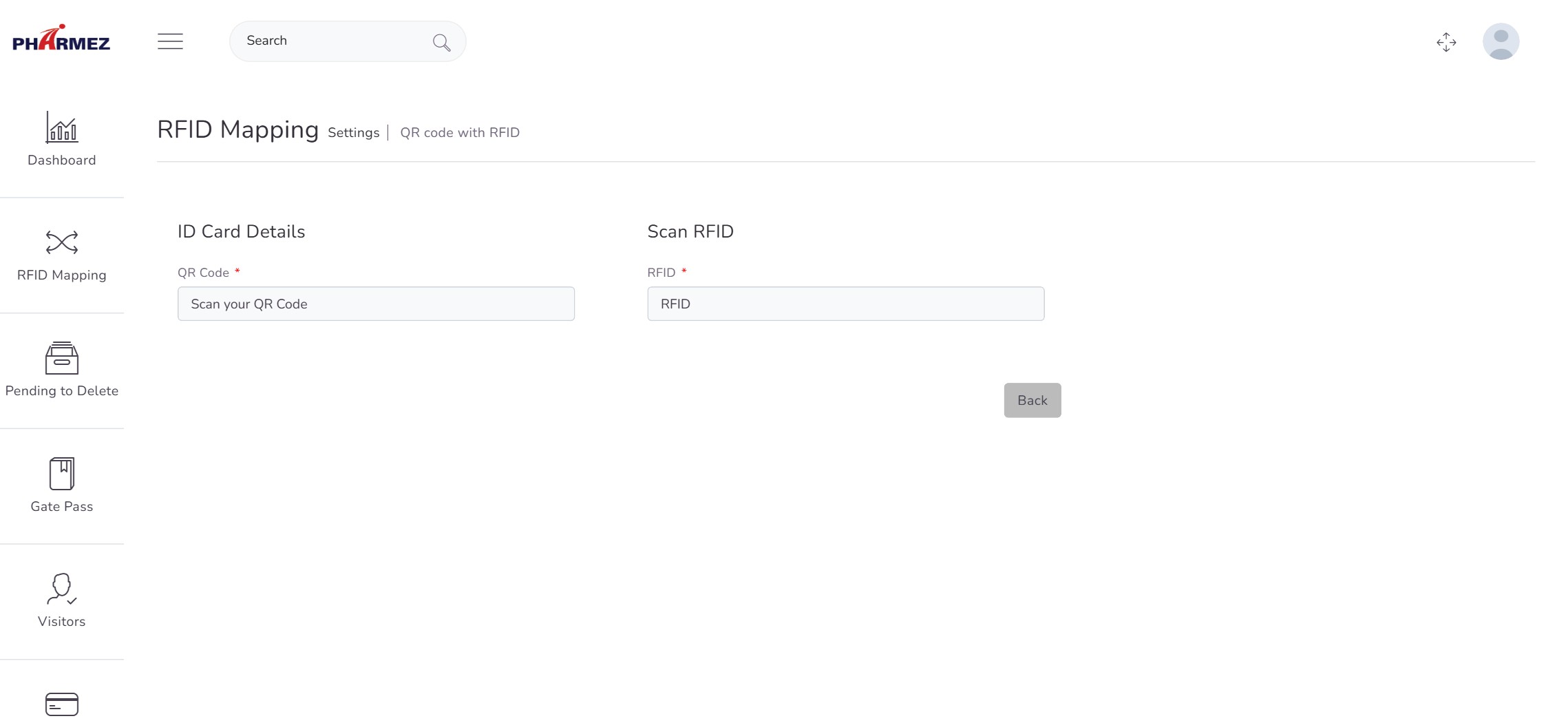
Identity is issued as a temporary or permanent card against a unit and, where relevant, a contractor. Photographs are captured through the browser, cards are approved in bulk and printed in bulk, and print and deletion events are logged.
Mapping the card to a QR code and an RFID credential is what turns an identity document into an access credential. It also means a lost or expired card is a data change rather than a physical retrieval problem, because validity is checked at the point of scanning.
Worth stating plainly: RFID at the gate is an operational choice here, not a legal requirement. Indian customs rules mandate RFID e-seals on export containers, but prescribe no technology for gate access.
Visitors are registered against the unit hosting them, with contact details, remarks and an approval status, so the estate always has a named host for every person inside the boundary. Contractors, contractor material and employee vehicles are handled as their own registers.
In a multi-tenant estate this matters more than in a single factory. The operator controls the boundary but does not employ most of the people crossing it, so every entry has to attach to a unit that accepts responsibility for it.
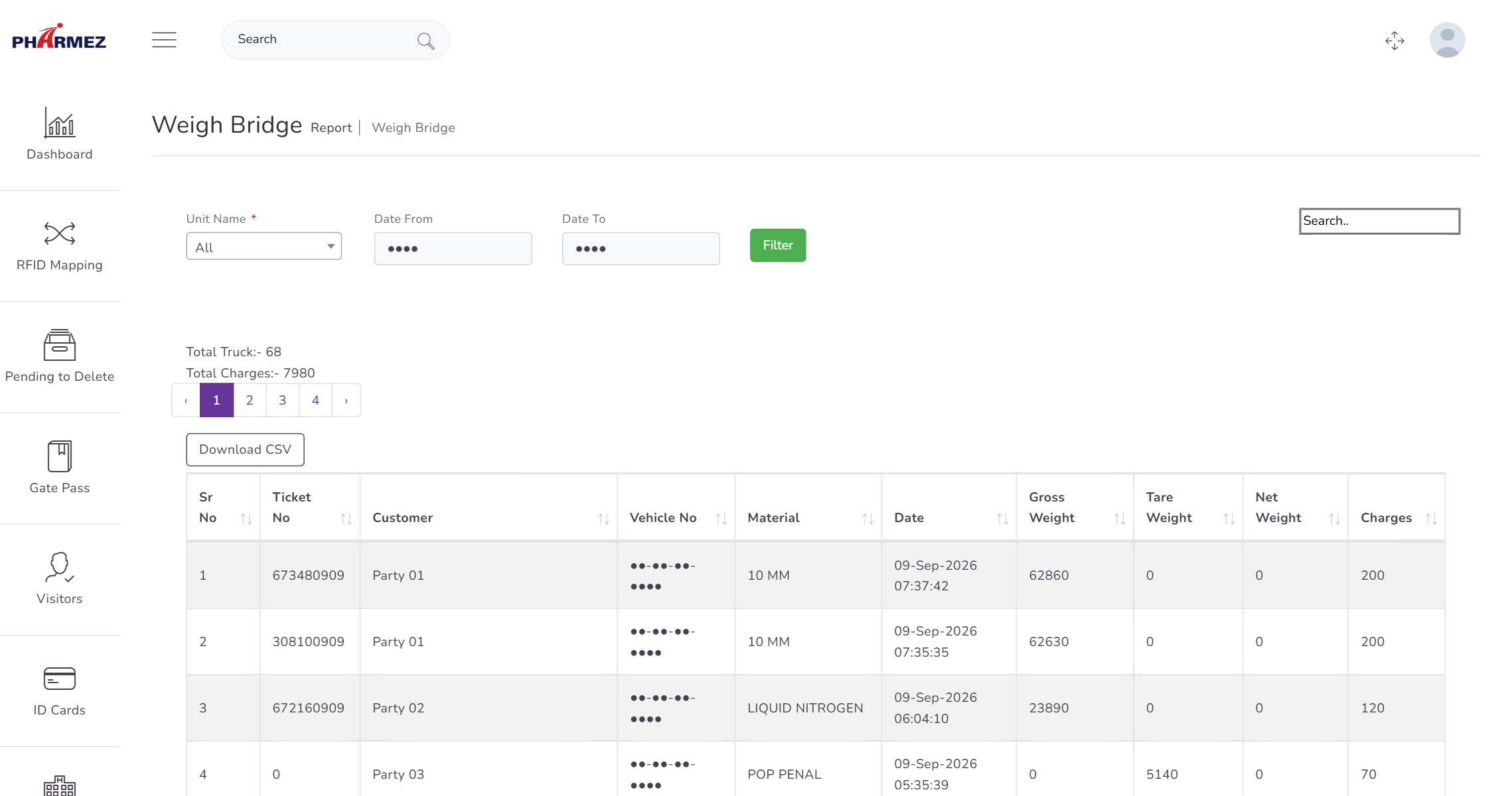
Each weighing produces a ticket with the party, vehicle, material and the three weights that matter, plus the charge raised. Totals for trucks and charges run across the filtered period, and results export for billing and reconciliation.
A weighbridge used in a commercial transaction in India is regulated equipment. It must be verified and stamped by a Legal Metrology Officer before use, and a platform weighbridge is re-verified every twelve months. Holding tickets in a system rather than on a roll of paper is what makes that history retrievable when it is asked for.
The identity card also carries a balance. The ledger records each transaction with its type, what it was for, the department, the unit and the amount, alongside recharge history and failed payment tracking.
Kept genuinely closed loop, issued by the estate and spent only at its own facilities with no cash withdrawal, an instrument of this kind sits outside the Reserve Bank's prepaid payment instrument authorisation regime. That boundary is a design constraint worth stating, because adding third-party outlets or cash-out would change the position.
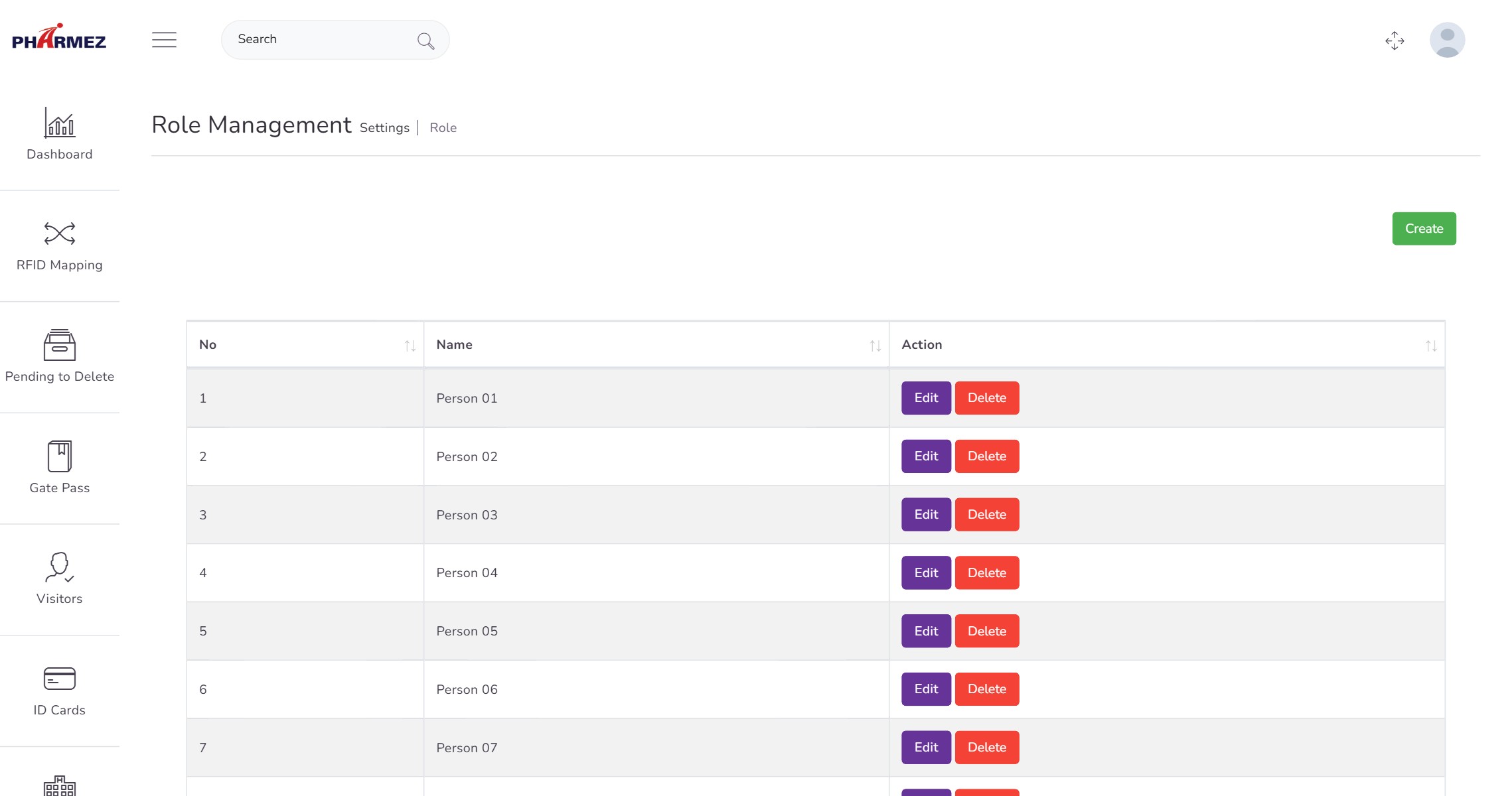
The role list reflects the real division of authority at a zone: the estate operator, the unit manager who raises movements, security and gate security who check them, HR who sponsor identity, medical, store, contractors, and the customs officer who authorises.
Auditors have criticised SEZ systems on exactly this point, finding access privileges not restricted on a need-to-know basis and overlapping duties between officers. Separating those roles in software is cheap; discovering afterwards that one person could raise, approve and delete a movement is not.
End to end
The same chain runs whether what crosses the boundary is a consignment, a contractor or a visitor.
Impact
Movements are categorised, not generic. A temporary removal and a domestic tariff area removal are different obligations, and the system treats them that way.
Identity is verifiable at the barrier. Validity is checked against a live record rather than by looking at a laminated card.
Every crossing leaves a row. The scan log gives the estate a continuous account of who and what passed which gate, and when.
Responsibility is always attached. Visitors and contractors sit against a host unit, so no one is inside the boundary unaccounted for.
Withdrawals need authority. Deleting a pass is a request that queues for approval rather than an action anyone can take.
Records survive the shift. Weighbridge tickets, print logs and scan history remain queryable long after the people involved have gone home.
Engineering approach
Seven movement types with distinct registers, rather than one gate pass with a type field, because the approval route and the obligation differ for each.
A person holds one identity with a validity window; the card, the QR code and the RFID tag are credentials mapped to it and revocable independently.
The operator runs the boundary but the units employ the people, so every card, pass and visitor attaches to a unit and scoping runs through the whole system.
Removing a movement record is the most sensitive action in a customs-controlled estate, so it queues for approval instead of executing.
Scanning, webcam capture and a mobile role exist because the people doing this work are standing at a barrier, not sitting at a desk.
Customs filing stays in the government systems. The estate system owns the gate and reconciles against those documents rather than pretending to replace them.
Common questions
Because two different problems meet at the same barrier. Visitor management handles people. An SEZ gate also handles duty-free goods crossing a customs boundary, where the movement category determines the obligation and where an unclosed temporary removal is a liability. A system that models only people leaves the more expensive problem unsolved.
No. Indian customs rules mandate RFID e-seals on export containers, and a July 2026 Department of Commerce instruction directs the use of RFID seals on SEZ export containers for uniform acceptance at gateway ports. There is no mandate for RFID personnel badges or RFID gate barriers. SEZ Rule 70 requires a record of entries at the gate but prescribes no medium, so RFID here is an operational decision about speed and accuracy, not compliance.
No, and it should not try. Customs filing for SEZ units runs through the government systems, with non-IT SEZs moved to ICEGATE from July 2024. This system owns the estate's own gate control and reconciles against those filings. Any vendor claiming direct integration with the SEZ filing portal should be asked to show the documented interface.
Every card, gate pass, visitor and vehicle attaches to a unit, and roles scope what each user sees. Unit managers work within their own unit while the estate operator, security and the customs function see across the zone. In an estate where tenants are competitors, that separation is a requirement rather than a preference.
A genuine closed-loop instrument, issued by the employer and redeemable only at its own facilities with no cash withdrawal and no third-party settlement, falls outside the Reserve Bank's prepaid payment instrument authorisation regime. That position depends on staying closed loop, so adding outside outlets or a cash-out route is a decision to take with advice rather than in a sprint.
The structure generalises well to any site with a controlled boundary, multiple tenants or contractors and goods movements that must be accounted for. What changes is the movement categories and the approval routes, which follow the site's own consent conditions and customs status. We map those first and build to them.
Why Div Systems
We build operational platforms for organisations whose processes carry regulatory weight: controlled boundaries, chains of custody, statutory documents and records that have to reconcile under audit. The work starts with reading the process and the obligations behind it, and ends with a system the gate and the office both use.
Start your project