- contact@divsystems.in
- Mon - Fri: 10.30 am - 7.30 pm
We are creative, ambitious and ready for challenges! Hire Us

Overview
Div Systems built the visitor gate pass system for a fine chemicals manufacturer, covering the request, the host who authorises it, what each visitor may carry past the gate, and the exit time that closes the record.
A pass is raised against a named host with a departmental reference, lists every visitor arriving in the group, and records for each one whether a mobile phone, a laptop or tools are permitted. The gate works from a live list of today's expected visitors, marks people out as they leave, and keeps a searchable register behind it.
Business need
A chemicals plant admits contractors, engineers, auditors, transporters and customers every day, into an environment where the site's own staff work to permits and to zone rules. Until recently, Indian factory law barely acknowledged those people. Section 7A of the Factories Act 1948 required the occupier to ensure the health and safety of workers, and its every limb was framed around workers.
That changed on 21 November 2025, when the Occupational Safety, Health and Working Conditions Code 2020 came into force and repealed the Factories Act. Section 6(1)(h) of the Code makes the employer responsible for the safety and health of employees, workers "and other persons who are on the work premises of the employer, with or without his knowledge". The last clause is the interesting one. A person the site failed to record is still the site's responsibility.
Alongside that sits a duty with a longer history. Rule 13(2) of the Manufacture, Storage and Import of Hazardous Chemical Rules 1989 requires the occupier to ensure that every person on the site who is affected by the on-site emergency plan is informed of its relevant provisions. Not every worker. Every person.
The plant needed a system that could:
Worth saying plainly, because the software industry usually does not: no Indian rule requires a live register of who is on site. Not the MSIHC Rules, not the Chemical Accidents Rules, not the OSH Code's own register provisions. What the law requires is that people on site are briefed, and that the employer answers for them. Knowing who is inside is how a site does those things, not a duty in itself.
Our solution
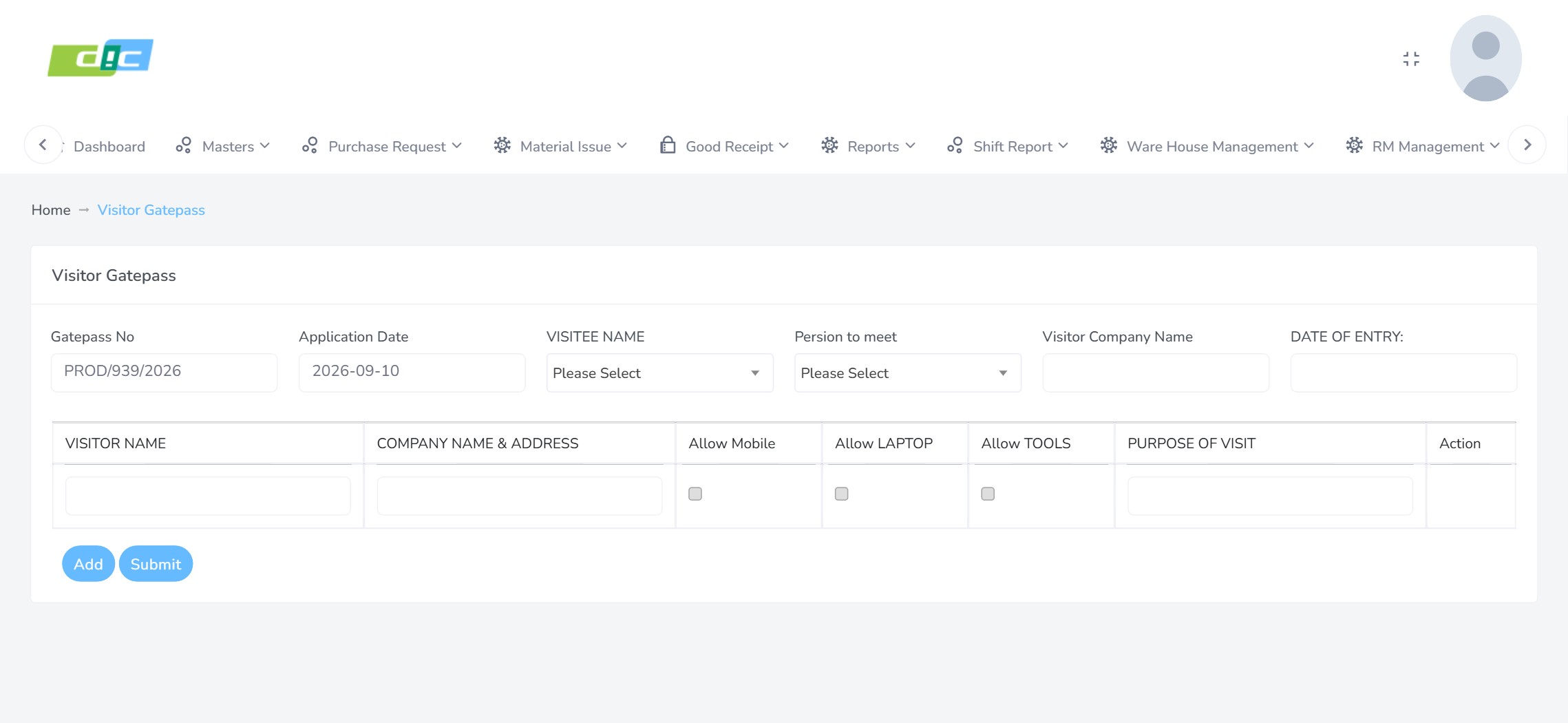
A visit is raised before it happens, by the department expecting it. The pass records the host and the person to be met, the visiting company, the date of entry, and a line for each individual arriving. Because the pass exists ahead of the visit, the gate is checking an expectation rather than taking a stranger's word at the barrier.
Two design decisions do most of the work. The first is that a host is mandatory, so responsibility for every person inside attaches to a named employee. The second is that permissions are set per visitor rather than per visit, because the engineer who needs a laptop and the colleague accompanying him are not the same case.
The record closes at the end. Setting an out time is what converts a list of people who were admitted into a list of people who are still inside.
Key features
Pass numbers are generated per raising department and year, so a reference identifies where a visit came from without a lookup.
Both the host and the person to be met are recorded, so every visitor on site has a named employee answerable for them.
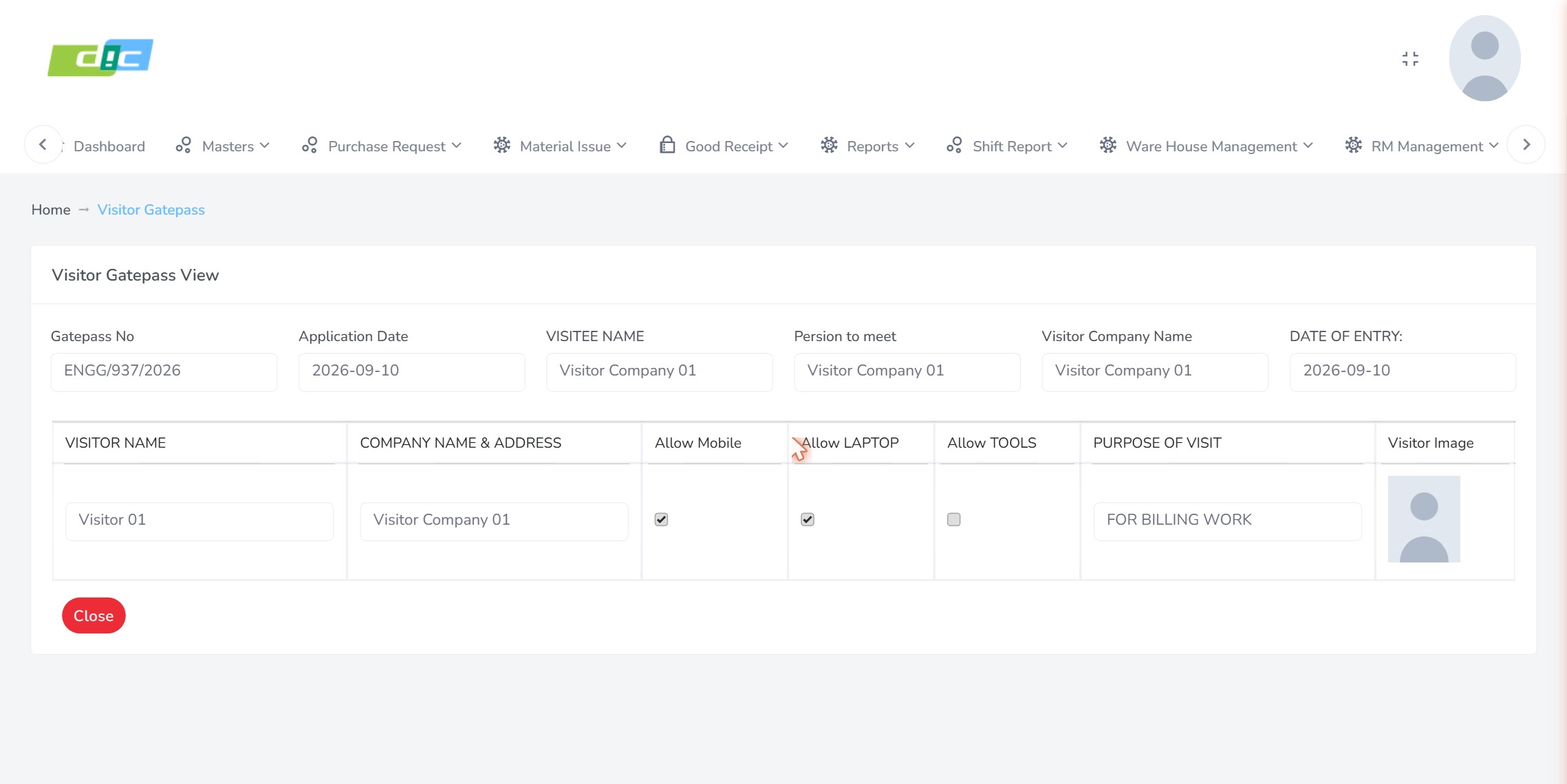
Several visitors arriving together are lines on a single authorised visit rather than separate unconnected entries.
Mobile phone, laptop and tools are allowed or refused individually, so the decision is recorded rather than argued at the barrier.
Each visitor line states why that person is attending, which is what makes a pass reviewable afterwards.
An image is held against the visitor record for identification at the gate during the visit.
Passes carry an explicit approval state, so an unapproved visit is visibly unapproved rather than quietly admitted.
The gate works from a filtered list of the day's visits instead of paging through the full register.
Marking an out time against the pass is a single action, which is what makes it likely to happen during a busy shift.
A pass can be printed for the visitor to carry and for security to check against the person in front of them.
The full history is searchable and paginated, so a past visit can be produced when a question is asked months later.
Passes can be viewed, edited and removed, with the register reflecting the current state of each visit.
Inside the module
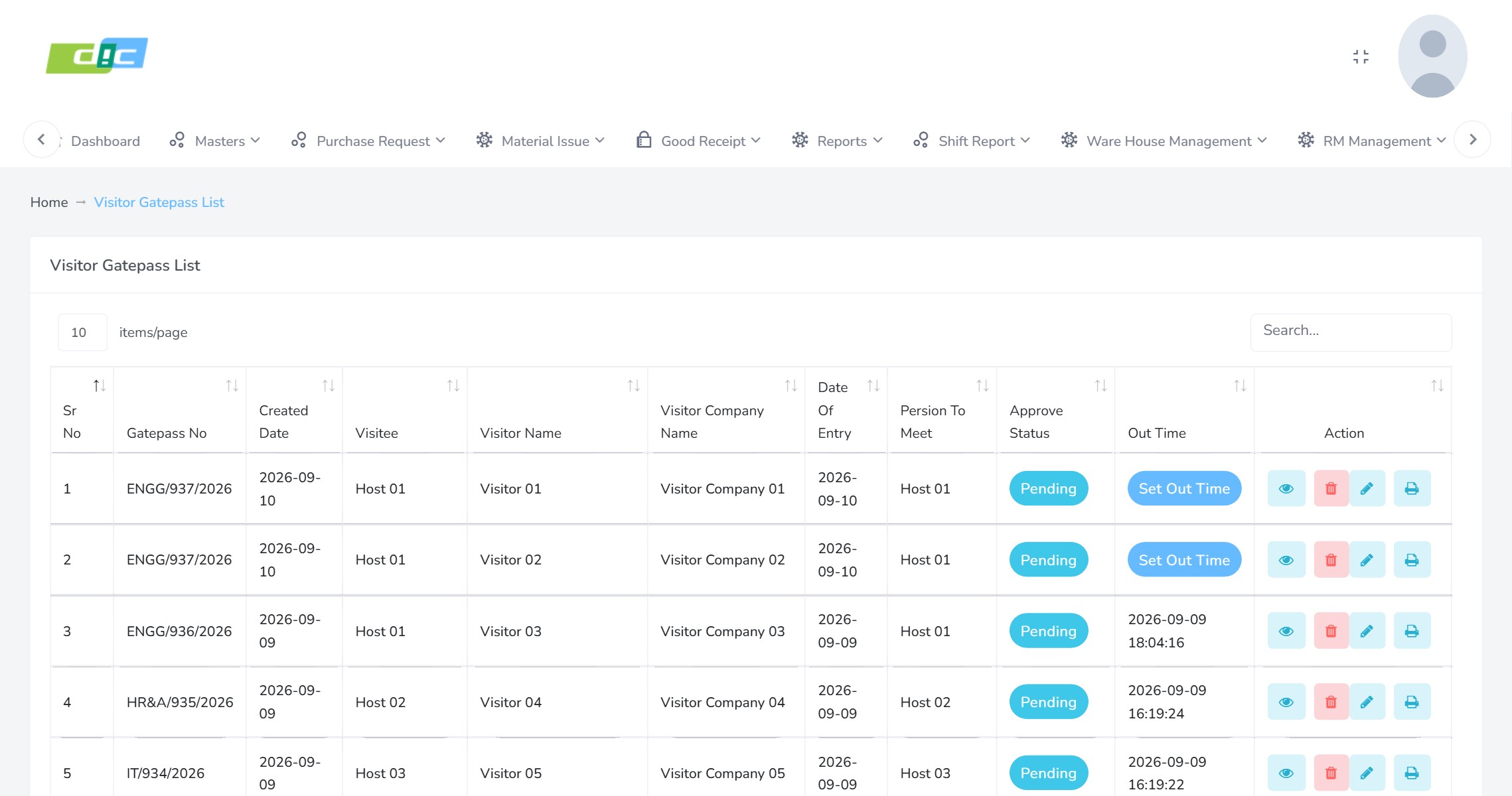
Screens from the live system. Visitor names, host names, employers and photographs are masked; structure and workflow are unchanged.
The three checkboxes on every visitor line, for a mobile phone, a laptop and tools, look minor and are not. In a plant handling flammable solvents, an uncertified electrical device is an unassessed potential ignition source, and the law in a classified hazardous area works by permitting only certified equipment rather than by proving any particular device dangerous.
The honest position is worth stating. Inside the classified areas of petroleum-licensed or compressed-gas-licensed premises, uncertified portable electrical apparatus is prohibited by rule. Elsewhere on a solvent-handling site it is a site rule arrived at by risk assessment, discharging the general duty to exclude ignition sources. Either way the decision belongs to someone accountable, taken before the visitor arrives, and recorded.
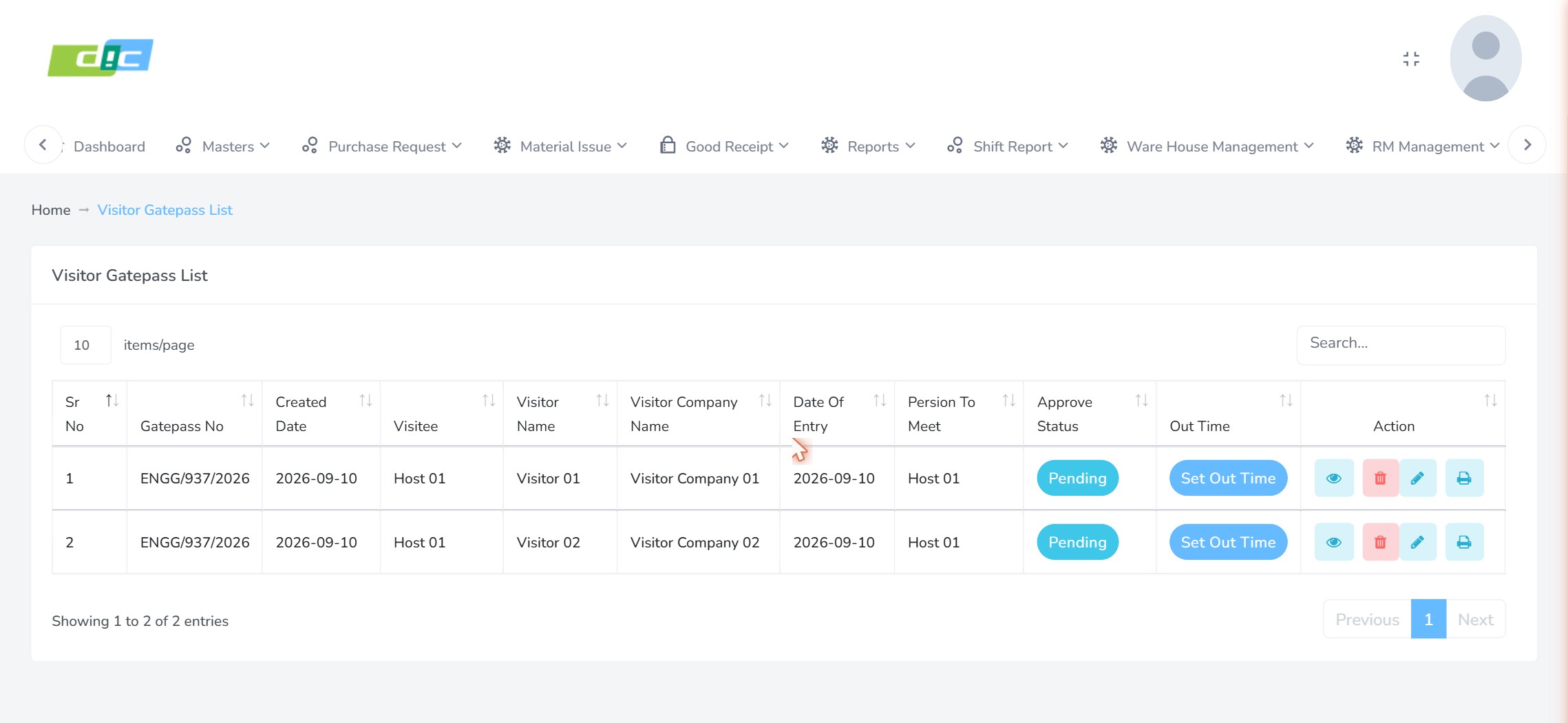
Security does not need the whole register. It needs today, and it needs the exit action to be one click, because the moment a visitor is leaving is the moment nobody has time.
Official fire safety guidance treats the roll call as a core control and is specific about its output: note anyone unaccounted for, and pass that information to the fire and rescue service on arrival. A register that people sign into but not out of produces false positives, which sends responders looking inside an active incident for people who left at lunchtime. That is the argument for capturing exits, and it rests on how the control works rather than on a statistic. Claims that paper registers fail are, in the published literature, largely made by people selling the alternative.
A visitor register holds names, employers, contact details and photographs. There is a nuance here that most vendors skip: India's Digital Personal Data Protection Act applies to digital personal data and to data digitised later, so a paper book that is never digitised sits outside it. Going digital is what creates the obligation.
The Act's substantive provisions are not yet in force. They commence around May 2027, and until then a company is governed by the older reasonable-security regime under the IT Act. So the accurate claim for a system like this is that it is ready for what is coming, not that it delivers compliance today. Designing for it now is cheap: collect only what the visit requires, keep the photograph for identification during the visit rather than indefinitely, and be able to answer what is held and why.
One more distinction worth keeping straight. Under the new Act a photograph is ordinary personal data, because the Act has no sensitive category. A face-recognition template is a different object, and is biometric information under the rules currently in force. This system stores a picture, not a template.
End to end
Six steps, and the last one is the one most systems leave out.
Impact
Responsibility is attached before arrival. A visit exists in the system with a named host before anyone reaches the barrier.
Device decisions are recorded. What a visitor may carry is settled by someone accountable rather than negotiated at the gate.
Presence is a fact. Capturing exits is what makes a list of people inside worth acting on.
The gate has a working screen. Today's list beats searching a register while someone waits.
History is retrievable. A visit from months ago can be produced without opening a cupboard.
Personal data is deliberate. What is collected is what the visit needs, ahead of obligations that commence in 2027.
Engineering approach
Modelling device permissions per visitor rather than per visit matches how the decision is actually taken, and avoids a group inheriting one person's clearance.
Making the host a required field is what turns a visitor log into an accountability record, and it is the field a site relies on when something goes wrong.
The out time is a single button on the day's list, because a control that competes with a queue at the gate will lose.
A departmental series in the pass number makes origin readable without opening the record, which matters when reviewing a month of visits.
Storing an image for gate identification avoids creating biometric data, which carries materially heavier obligations for no operational gain here.
Data minimisation and purpose limitation were designed in ahead of the 2027 commencement rather than retrofitted afterwards.
Common questions
Yes, and this is recent. The Occupational Safety, Health and Working Conditions Code 2020 came into force on 21 November 2025 and repealed the Factories Act 1948. Section 6(1)(h) makes the employer responsible for the safety and health of employees, workers and other persons on the work premises, with or without the employer's knowledge. The repealed section 7A of the Factories Act ran only to workers, so this is a genuine change rather than a restatement.
No. We looked for this specifically and it does not exist in Indian law. The MSIHC Rules 1989, their Schedule 11, the Chemical Accidents Rules 1996 and the OSH Code's register provisions contain no requirement for a live record of persons present. What Rule 13(2) of the MSIHC Rules does require is that every person on site affected by the on-site emergency plan is informed of its relevant provisions, which in practice cannot be done or evidenced without knowing who is there. Accurate presence data is the means of compliance, not the obligation.
Because an uncertified electrical device is an unassessed potential ignition source, and classified hazardous areas are managed by permitting only certified equipment. Inside petroleum-licensed or compressed-gas-licensed premises this is a statutory prohibition on uncertified portable apparatus. In a solvent area outside those licensing regimes it is a site rule set by risk assessment. It is worth adding that no confirmed case of a phone igniting vapour has been documented, so the control is about excluding unassessed equipment rather than about a proven mechanism.
Not today, and any vendor claiming otherwise is ahead of the law. The Digital Personal Data Protection Act 2023 had its rules notified in November 2025, but the substantive obligations covering notice, consent, purpose limitation, security and erasure commence around May 2027. Until then a company is governed by section 43A of the IT Act 2000 and the 2011 reasonable-security rules. A well-designed system is ready for the change; it does not deliver it early.
Technically yes, and it is worth understanding. The Act applies to digital personal data and to personal data digitised subsequently, so a paper register that is never digitised falls outside it. Digitising is what brings visitor data into scope. The answer is not to stay on paper, since paper fails the safety purpose, but to digitise with minimisation and retention decided deliberately.
A photograph is ordinary personal data under the new Act, which has no sensitive category. It needs a purpose, and the sensible purpose is identification at the gate for the duration of the visit, which means indefinite retention is the real exposure. A face-recognition template is a different matter: that is biometric information and sensitive under the rules currently in force. This system holds an image, not a template.
Why Div Systems
We build operational software for sites where the process carries real consequences, and we read the obligations behind it before writing the first screen. If your gate still runs on a book, or your visitor system was built for an office lobby rather than a plant, we would be glad to look at it with you.
Start your project