- contact@divsystems.in
- Mon - Fri: 10.30 am - 7.30 pm
We are creative, ambitious and ready for challenges! Hire Us

Overview
Div Systems built the operating system for a common effluent treatment plant serving a pharmaceutical SEZ, covering the journey of each tanker load from the member unit's request to the released test report and the monthly load-based bill.
Every consignment is raised as a waste water manifest with a printed QR-coded document, tracked out and in at the gate, sampled under a barcode, tested across a laboratory workflow, cross-checked against the plant's instrument reading, released to the member by email and priced on measured effluent load. Member unit logins, a certificate register and a field-level audit trail sit around it.
Business need
A common effluent treatment plant exists so that an industrial estate treats its effluent collectively rather than unit by unit. As the Central Pollution Control Board puts it, that also makes enforcement simpler, because the regulator monitors one point instead of hundreds. The difficulty is what happens before the effluent arrives.
Where units are not piped to the plant, effluent travels by road tanker. CPCB's national review of CETP performance was blunt about the risk: collection of wastewater from individual industries through tankers "is not a foolproof system and should be discouraged in new areas and reviewed and rectified in old ones". Tanker conveyance was nonetheless the norm across Gujarat's chemical and pharmaceutical estates. A plant that receives effluent this way has to build its own controls, and needed a system that could:
Two documented failure modes shape the design. Gujarat Pollution Control Board's own inspection checklist asks whether a unit's logbook, its online manifests and its disposal records are tallying, and a real inspection report annexed to a National Green Tribunal filing answers that question "Partially". Separately, a randomised controlled trial run with GPCB across 473 audit-eligible plants found that 29 per cent of third-party audit reports falsely reported readings as below the regulatory standard, and that 73 per cent of reported readings clustered in the narrow band between 75 and 100 per cent of the limit, against 19 per cent in independent backchecks.
Reconciliation and verification are therefore not administrative niceties in this sector. They are the control.
Our solution
Each tanker load becomes a manifest, and the manifest becomes the object every later step attaches to. The gate stamps its out and in times against it. The laboratory receives the sample against it under a barcode. Every test result, whether an instrument parameter, a titration or a gravimetric weighing, is stored against it. The released report references it, the sample destruction record closes it, and the monthly bill is built from it.
Because custody is modelled explicitly rather than implied, the plant can answer the regulator's question directly: for any date range, which consignments were raised, which arrived, which were tested, which were reported and which are still open.
A separate control sits over the numbers themselves. The plant's own reading for a load is held alongside two independent laboratory determinations, and the system shows the percentage difference between them.
Key features
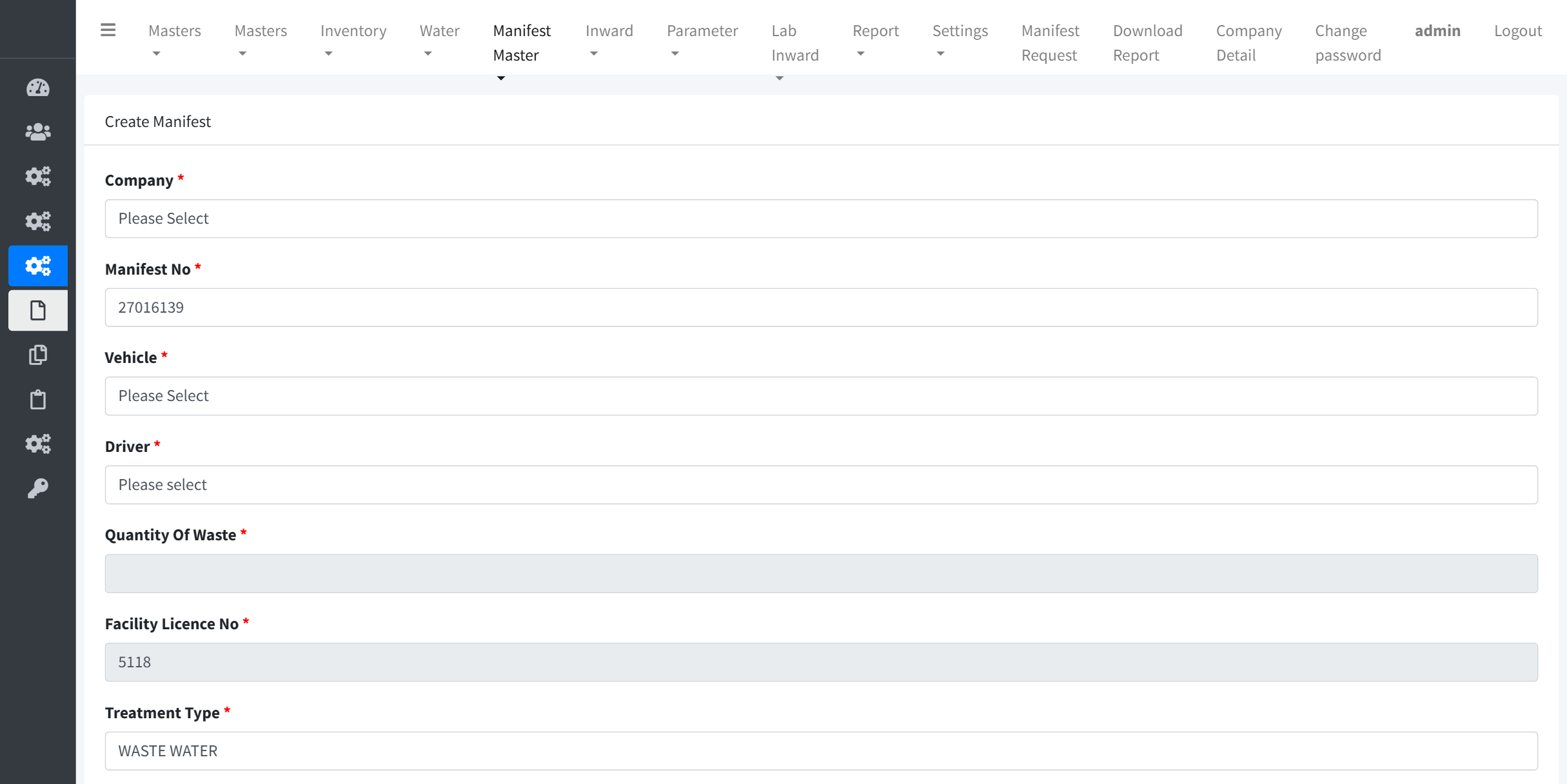
Every consignment is raised against a member unit with vehicle, driver, quantity, treatment type and facility licence number, and prints as a QR-coded document.
Member units raise their own collection requests with water type, schedule and time, and see them queued for the plant to action.
Tanker out and in times are recorded per manifest, and the difference is reported so turnaround and unexplained gaps are visible.
Samples enter the laboratory under a printed barcode, so test entry starts from the code rather than from the member unit's name.
pH, conductivity, TDS, TSS and temperature are captured against the barcode in one pass at the bench.
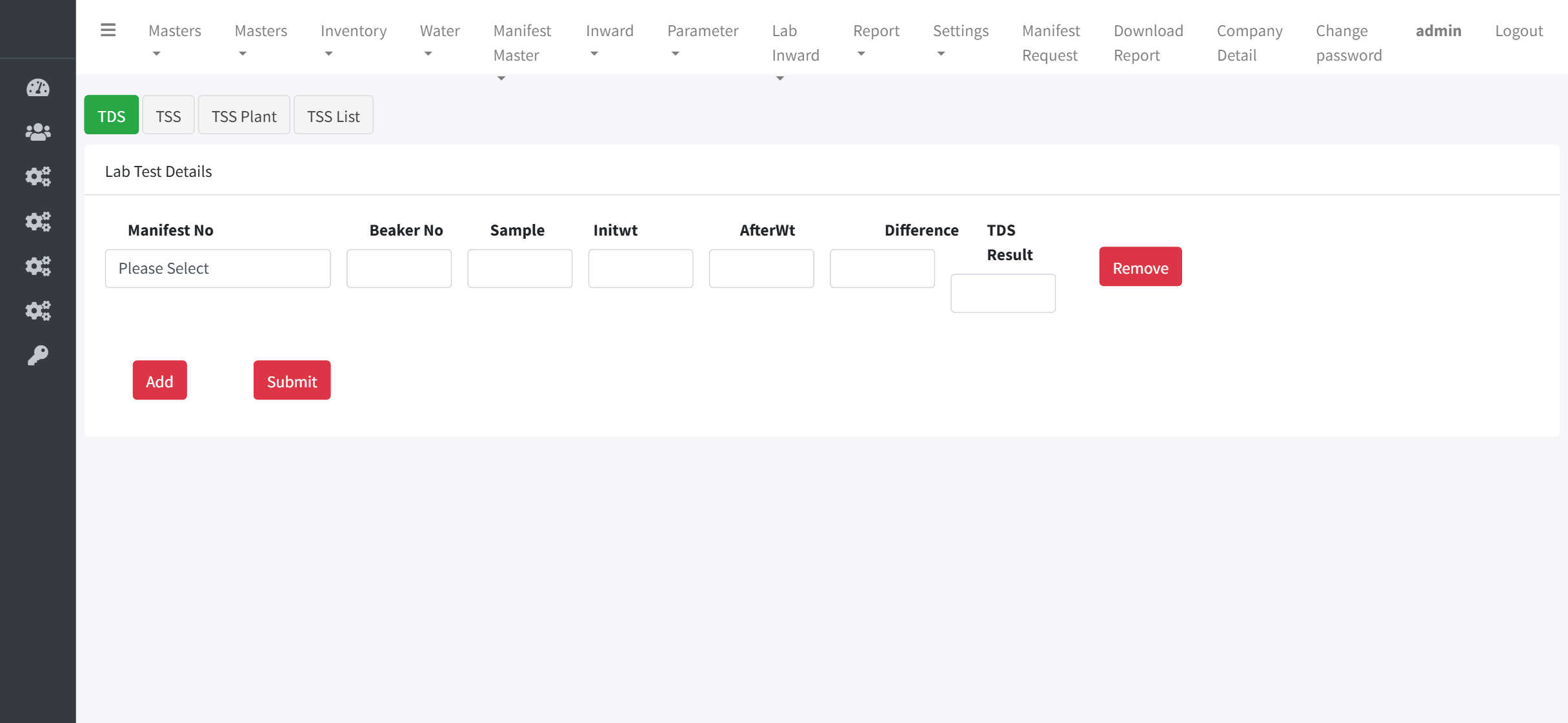
Oven and beaker entry records beaker number, sample, initial weight, final weight and the difference, then holds the calculated result.
COD entry holds sample volume and distilled water made up to twenty, and the other-test screen carries the blanks and dilutions a BOD calculation needs.
The plant reading, the instrument entry and the gravimetric result are shown side by side with the percentage difference between them.
Results are selected and mailed to the member unit per manifest, and the system records that the report was sent and when.
Samples are tracked through to destruction, and the pending report lists loads not yet inwarded, not yet reported and not yet destroyed.
Rates cover committed effluent, tanker and tested-tanker charges, cost per kilogram of COD and six TDS concentration bands.
Member certificates are held with type, issue date, expiry date, number and the certificate file, so lapses surface before they matter.
Meters are assigned per company and read on a schedule for borewell, raw, treated and Narmada water supply.
Vendor, machine and product masters carry laboratory inward, issue, return, warranty and calibration entries.
Every change records the entity, record, field, old value, new value, user and timestamp across the whole system.
Inside the platform
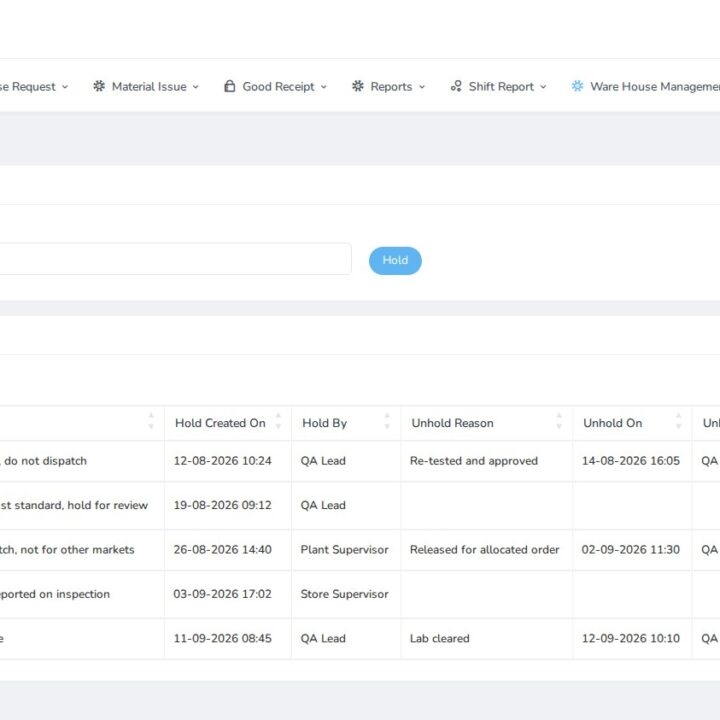
Screens from the live system. Member unit names, driver names, vehicle registrations and rates are masked; structure and workflow are unchanged.
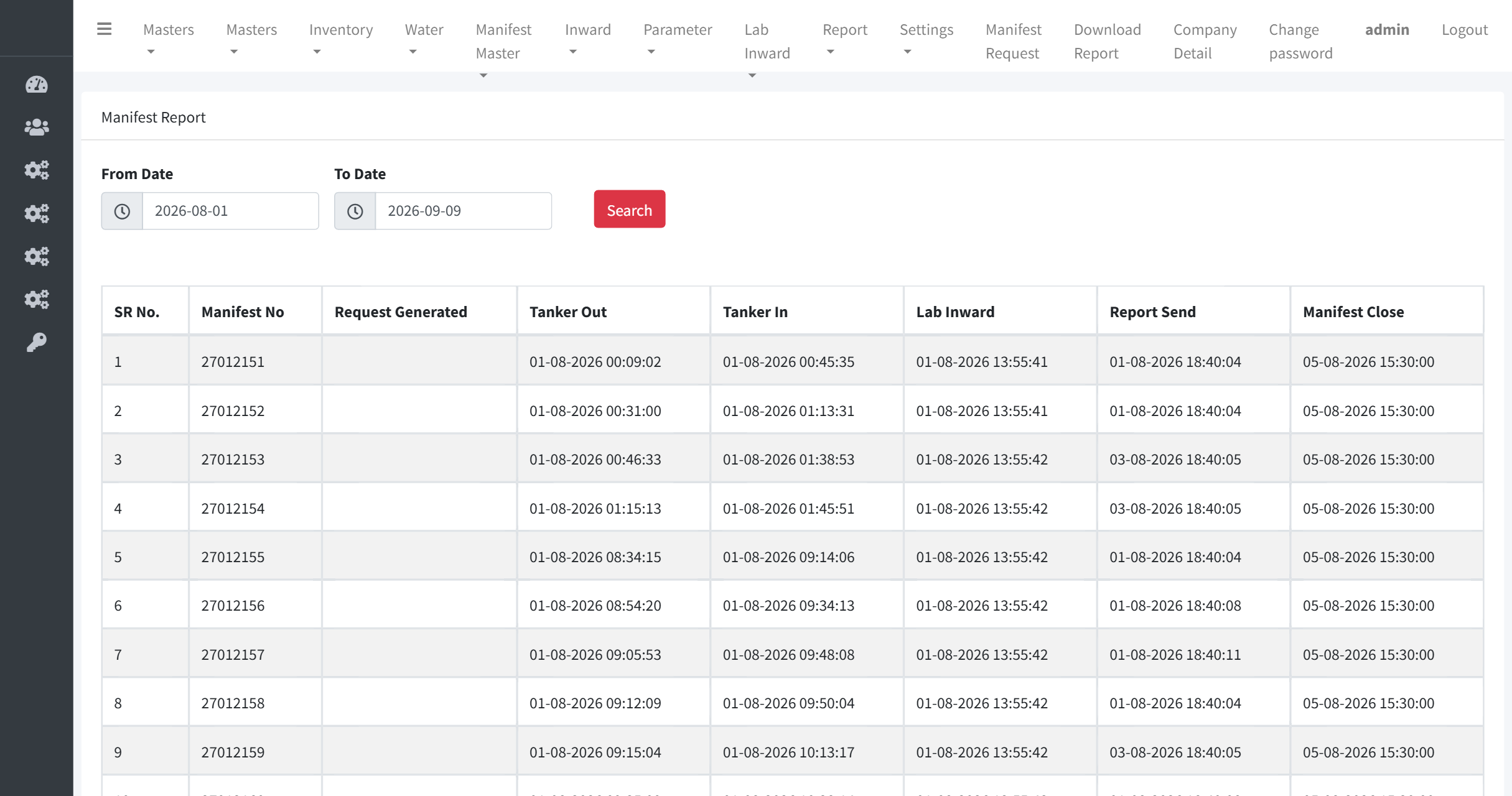
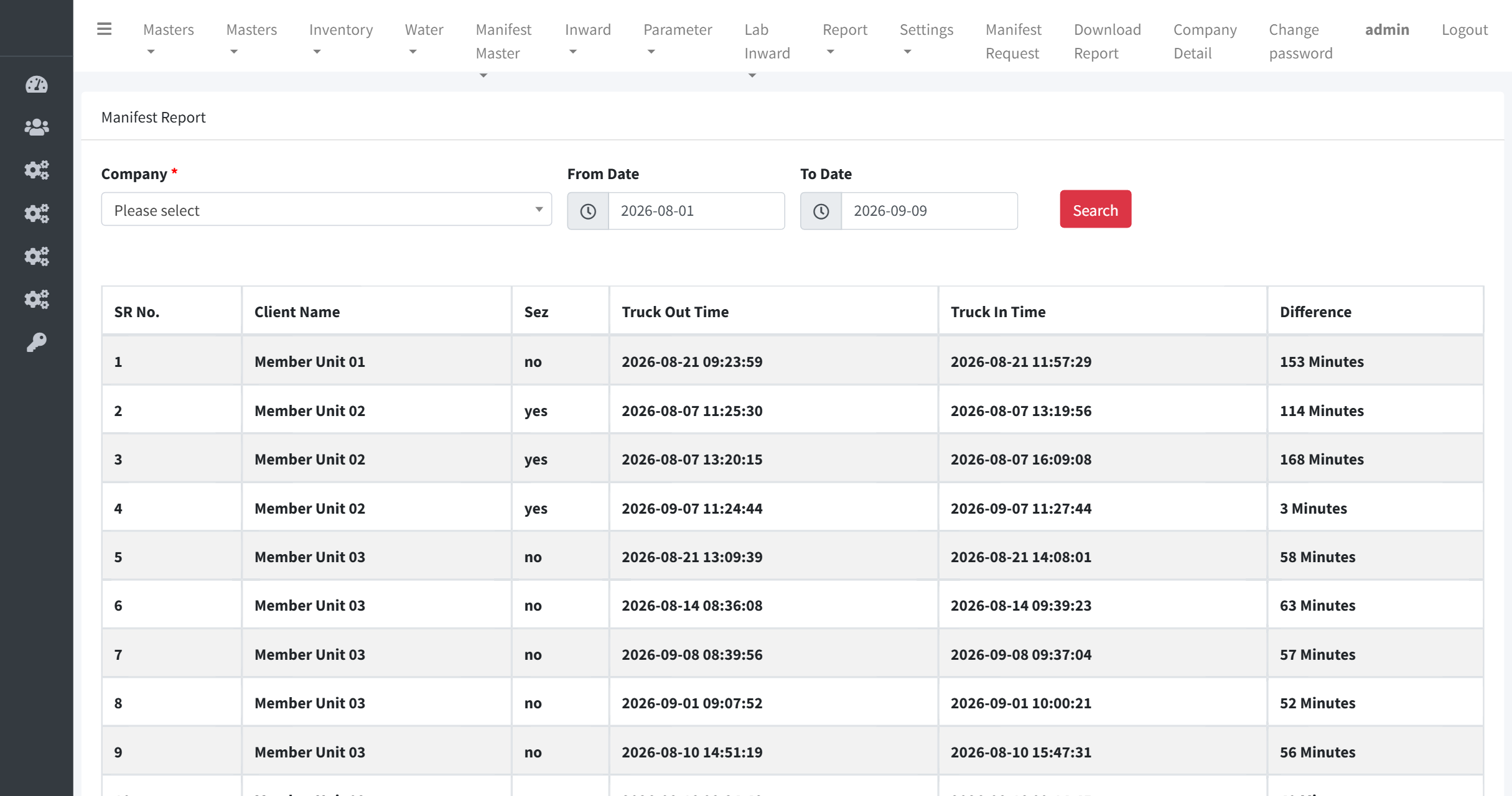
The manifest register separates inbound and outbound vehicle movements, and the tanker timing report pairs each out time with its in time and computes the difference. A consignment that leaves a member unit and takes an unusual time to arrive is visible as a number rather than as an anecdote.
The pending report works the other way round, listing manifests raised but not inwarded, inwarded but not reported, and reported but not yet destroyed, so nothing sits unfinished without appearing on a list.
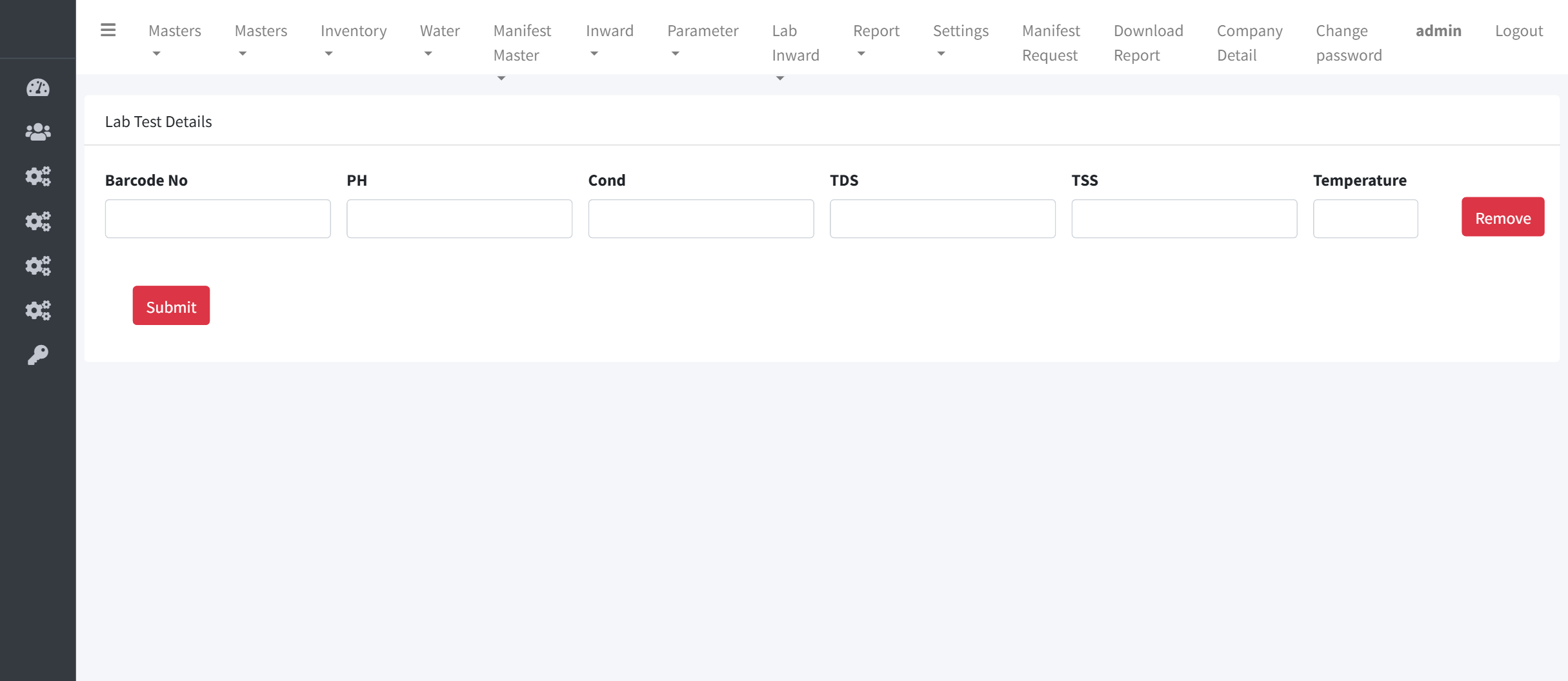
Manifests are inwarded to the laboratory and the sample carries a printed barcode. Every test screen is keyed by that barcode, so the analyst identifies the sample by its code rather than by whose effluent it is.
Blind coding of samples is an established control in Gujarat's own environment governance system, where sample collection is deliberately isolated from parameter testing and result reflection. Building the same separation into a plant laboratory removes an obvious source of pressure on a result.
The laboratory screens store the working, not only the answer. Gravimetric solids entry records the beaker number, the sample, the initial weight, the weight after drying, the difference and the result, which is what makes a solids figure defensible months later. COD entry holds the sample volume and the distilled water made up to twenty. The other-test screen carries the blanks and dilution readings a BOD calculation is built from.
Indian regulatory work reports BOD over three days at 27 degrees rather than the five days at 20 degrees used internationally, so a stored result is only meaningful alongside the conditions that produced it.
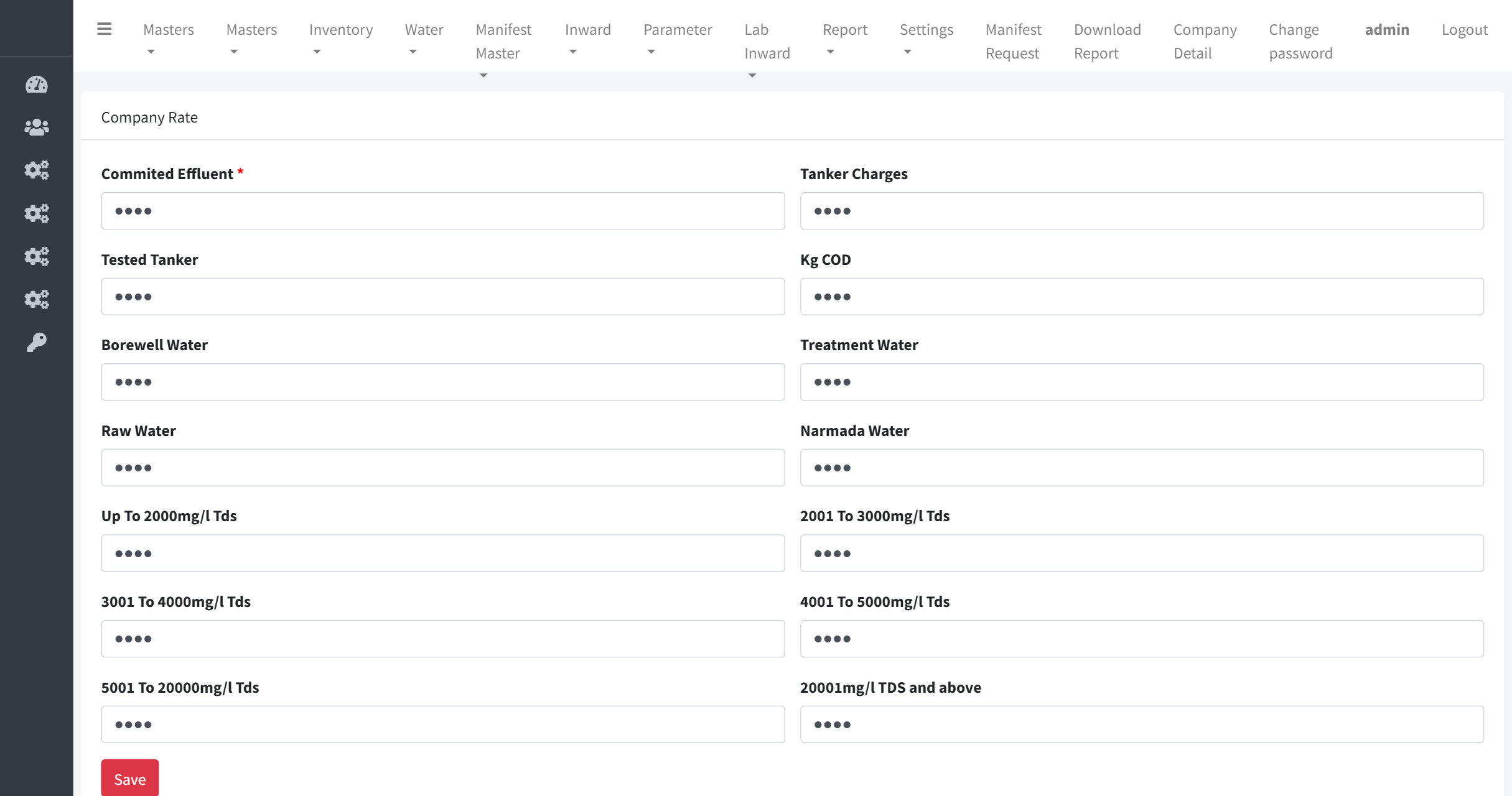
CETP charging in India is load-based rather than a flat fee, and this rate master reflects that directly: committed effluent, tanker and tested-tanker charges, a rate per kilogram of COD, water supply rates and six TDS bands running from below 2,000 milligrams per litre to above 20,000.
The manifest summary report assembles the month from the manifests themselves, giving committed effluent per day against effluent received in kilolitres, COD in kilograms, tanker trips, analysis charges, shortfall against commitment and the volume received in each TDS band.
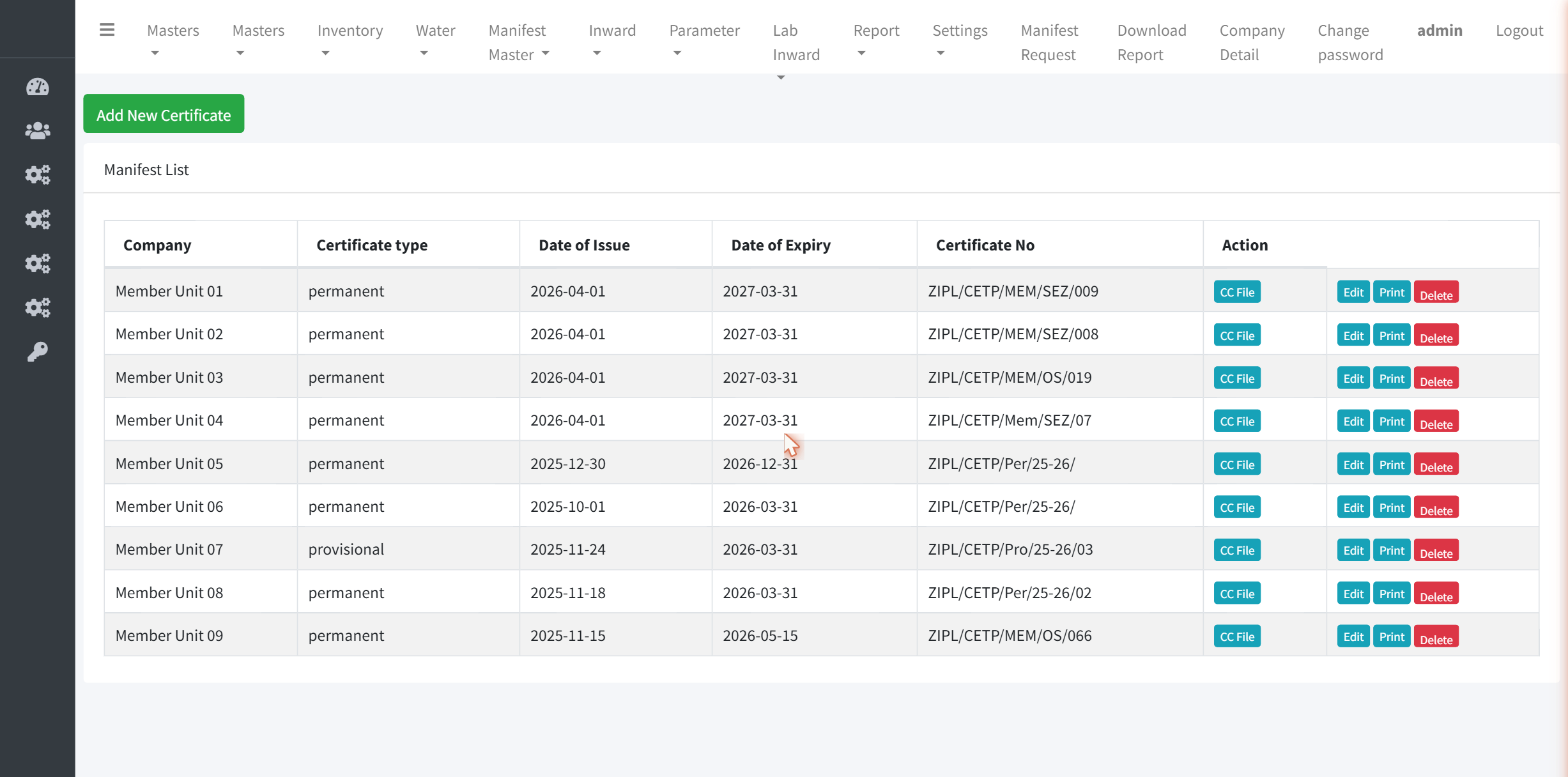
Membership of a CETP is a condition of a member unit's own consent, and an expired registration is a finding waiting to happen. The certificate register holds each member's certificate type, issue date, expiry date, certificate number and the certificate file itself.
Keeping validity as a date field rather than a filed document means the question of who is currently covered can be answered from the system rather than from a cabinet.
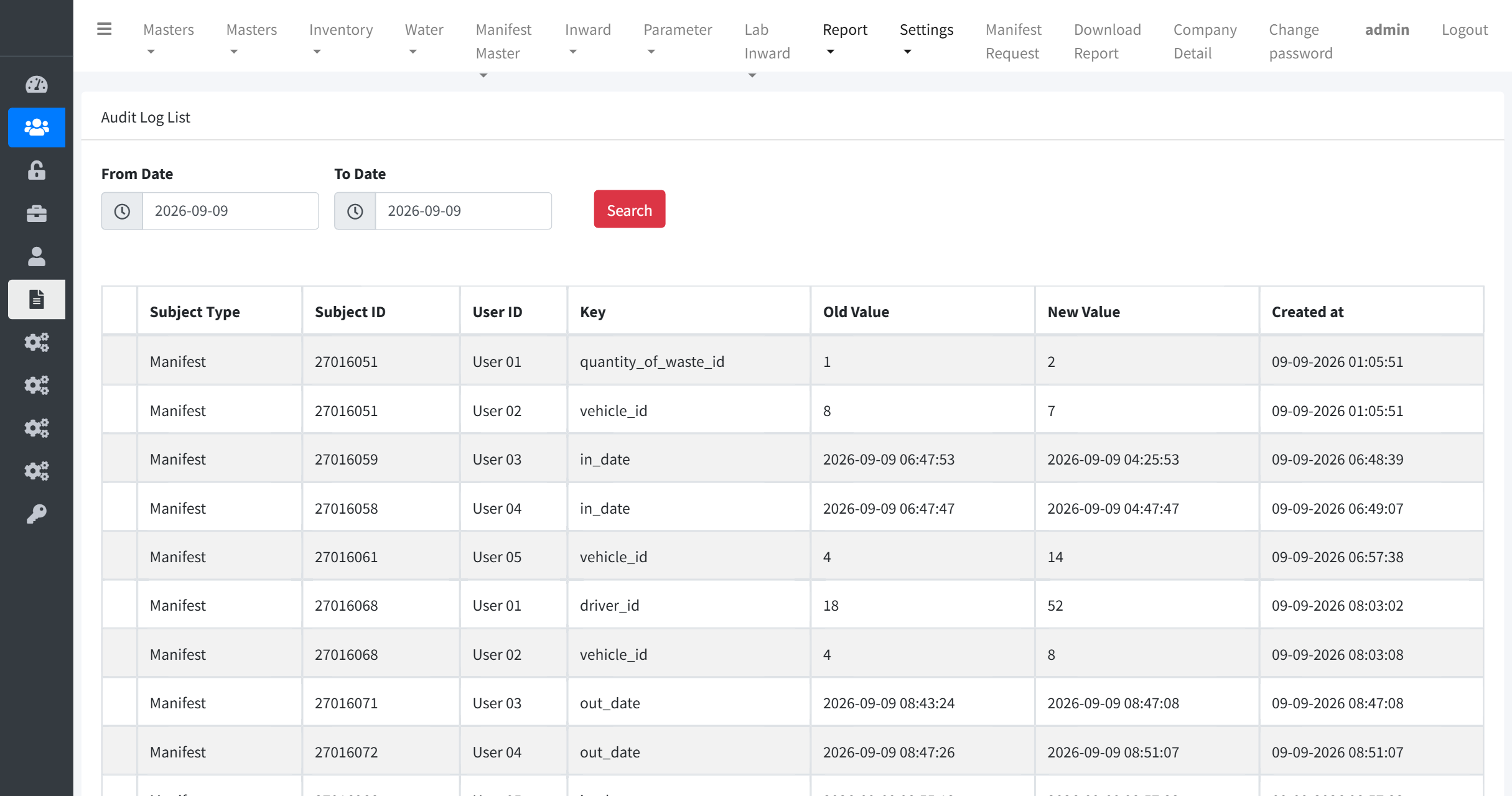
The audit log records the entity, the record identifier, the field, the previous value, the new value, the user and the timestamp. Where a laboratory result or a manifest quantity was amended, the log shows what it was, what it became and who changed it.
Continuous monitoring guidance in India is explicit that manual data handling should not be permitted and that any validated change must be recorded with date and time stamping. The same principle applies to the records a plant keeps for itself, because those are what an inspection reconciles against.
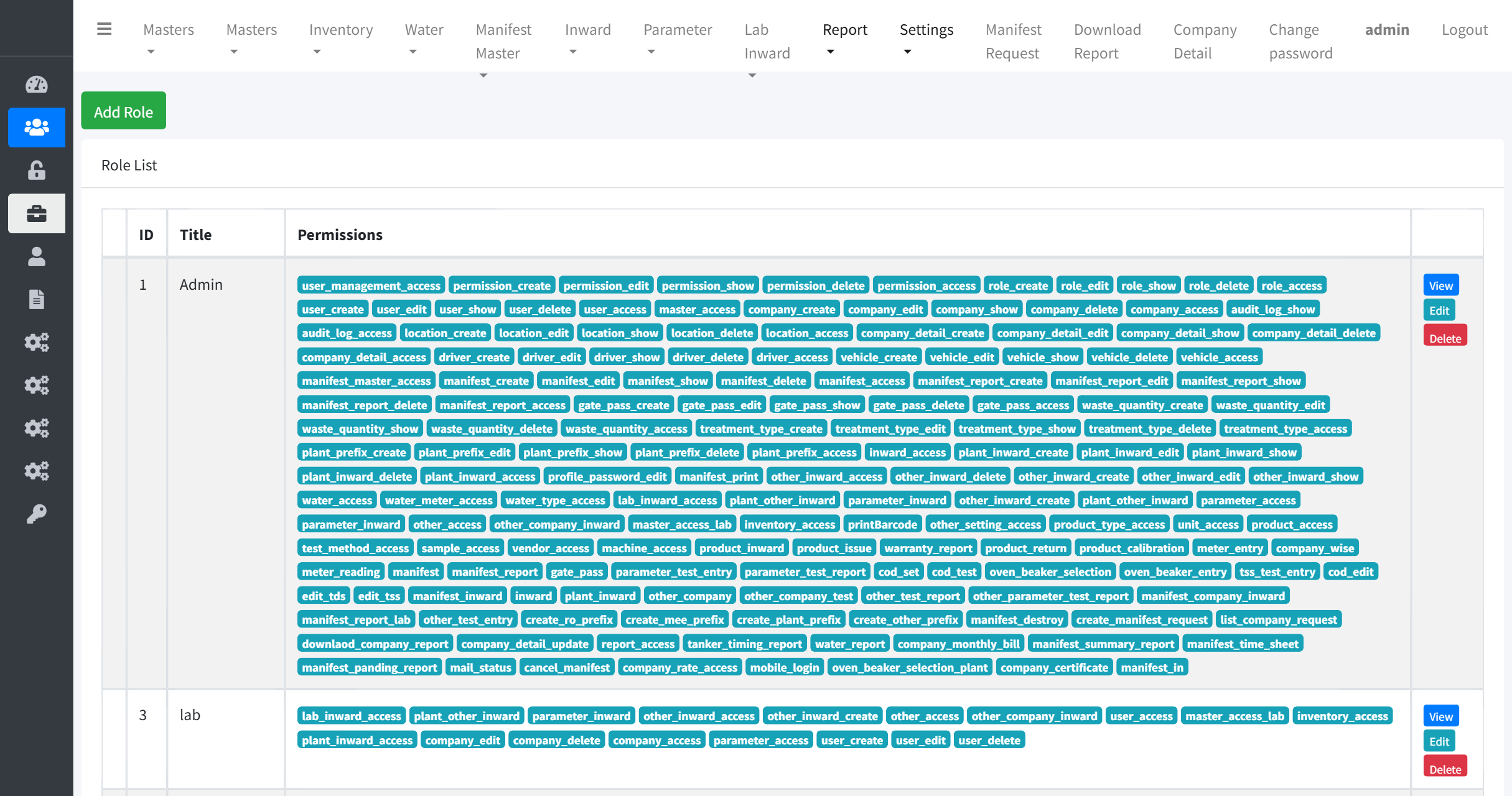
Around a hundred named permissions are assembled into roles covering plant administration, laboratory management, laboratory staff, plant operations, gate and vehicle handling, mobile access, and two distinct member-side roles for operations and environment, health and safety staff.
Member units therefore log in to raise collection requests and download their own reports without seeing anything belonging to another unit in the estate, which matters when the members are competitors in the same industry.
End to end
Each stage stamps the manifest, which is why the time sheet can show the whole journey on one line.
Impact
Custody is continuous. A consignment cannot reach the laboratory without a manifest, or be billed without a result, because each stage writes to the same record.
Results are defensible. Weights, volumes and dilutions are stored with the result, so a determination can be re-derived rather than taken on trust.
Verification is built in. Holding the plant reading beside two laboratory determinations turns a disputed number into a measurable difference.
Billing follows measurement. Volume, COD load and TDS band come from the manifests themselves, so the monthly statement reconciles to the consignments behind it.
Members serve themselves. Collection requests and report downloads sit behind member logins, scoped so one unit never sees another's data.
Records answer inspections. Manifests, movements, results and certificates are queryable by date range and reconcile against each other.
Engineering approach
The manifest is a hard dependency rather than a document produced afterwards, which is what keeps movements, samples, results and billing tied to the same consignment.
Test entry is keyed by barcode so the bench works from the sample. The design mirrors the blind coding already used in state environment governance.
Initial and final weights, sample volumes, blanks and dilutions are fields in their own right, because a result without its derivation cannot be defended.
Two laboratory determinations and the plant reading are held together with the percentage difference, so divergence surfaces as routine information.
Because charges depend on load, TDS bands and COD per kilogram are configurable master data rather than assumptions buried in a billing routine.
Plant staff, laboratory staff and member units work in the same application under separate roles, which removes the email round trip that usually sits between them.
Platform
A browser-based application used by plant operations, the laboratory, the gate and member units, with session authentication and role-based authorisation over a permission library, and field-level change logging across the data model. Documents are generated server side and printed with QR codes, and files including certificates are held against their records.
The system holds a plant-side reading for each consignment alongside laboratory determinations and reports the difference between them. Result release runs by email against the manifest, and the send is recorded.
Server framework, database engine, hosting arrangements and the mechanism by which plant instrument readings reach the system are confirmed by the delivery team rather than inferred from the interface.
Common questions
Four things at once. It has to establish custody of every consignment arriving at the plant, run the laboratory workflow that characterises it, price it on measured load, and keep records that reconcile against each other when an inspector asks. Systems that handle only one of those leave the reconciliation to spreadsheets, which is where it fails.
The Central Pollution Control Board has stated that collecting wastewater from individual industries through tankers is not a foolproof system and should be discouraged where technically possible. Where estates are not piped, the plant carries the control burden itself, which means documenting each consignment, its movement and its characteristics.
A solids figure is a difference between two weighings and a COD or BOD figure depends on volumes, blanks and dilutions. Storing only the answer makes it impossible to re-derive later, whether the question comes from a member unit disputing a bill or from an auditor.
Because independent verification is the documented weak point in this sector. A randomised study conducted with Gujarat Pollution Control Board found that 29 per cent of third-party audit reports falsely reported readings as compliant, with values clustering just below the limit far more often than independent backchecks did. Showing the difference between readings makes divergence ordinary and visible.
Yes. This system gives member units separate operations and environment, health and safety roles so they can raise collection requests and download their own reports, scoped so that no member sees another member's data.
The workflow generalises, but the specifics do not. Inlet norms are set per plant by the state board and vary widely, tariffs differ, and each estate has its own document conventions. We start by mapping the existing process and consent conditions, then build to those rather than to a template.
Why Div Systems
We build operational platforms for organisations whose processes carry regulatory weight: chains of custody, laboratory workflows, statutory documents and records that have to reconcile. The work starts with reading the process and its consent conditions, and ends with a system the plant floor and the laboratory will actually use.
Start your project